How Oolong Tea Is Made: The Complete Production Process
Oolong tea is one of China's most technically demanding tea categories. It sits between green tea and black tea, and its production depends on a controlled balance of withering, bruising, partial oxidation, fixation, shaping and roasting. Small changes in timing or temperature shift the final aroma from floral and buttery to roasted, mineral or honeyed. This guide walks through the complete production process, the choices that matter most, and what importers should look for when buying commercial lots.
What Is Oolong Tea?
Oolong tea is a semi-oxidized tea made primarily from the leaves of specific Camellia sinensis cultivars. In international tea classification, oolong sits between unoxidized green tea and fully oxidized black tea, with oxidation levels commonly ranging from about 10% to 70% depending on regional style [1]. That wide window is why oolong is not one flavor profile but an entire spectrum: a light Anxi Tieguanyin can taste almost green, while a heavily oxidized and roasted Wuyi rock tea can feel closer to black tea.
The defining feature of oolong is not only oxidation but also the physical manipulation of the leaf. During production, the leaves are repeatedly tossed or shaken to create controlled bruising along the leaf edges. This partial cell-wall damage triggers enzymatic oxidation in some areas while leaving other parts of the leaf relatively intact. The result is a complex cup that can combine green-tea freshness with black-tea depth in the same leaf.
The Production Process, Step by Step
Chinese national standard GB/T 30357.1 sets basic requirements for oolong tea processing and quality, including sensory characteristics, leaf integrity and moisture control [2]. Within that framework, most traditional oolong production follows a sequence of harvesting, withering, tossing, oxidation, kill-green, rolling, drying, roasting and sorting. Each stage changes the leaf in a measurable way.
Step 1: Harvesting and Leaf Standard
Oolong tea is usually harvested by hand. The picking standard is not just the bud; most oolong styles require a bud with two to four mature leaves. The larger, more mature leaves contain the compounds needed to survive repeated tossing and rolling without completely breaking down. Harvesting too early produces a fragile leaf with less structure; harvesting too late produces coarse, woody flavor.
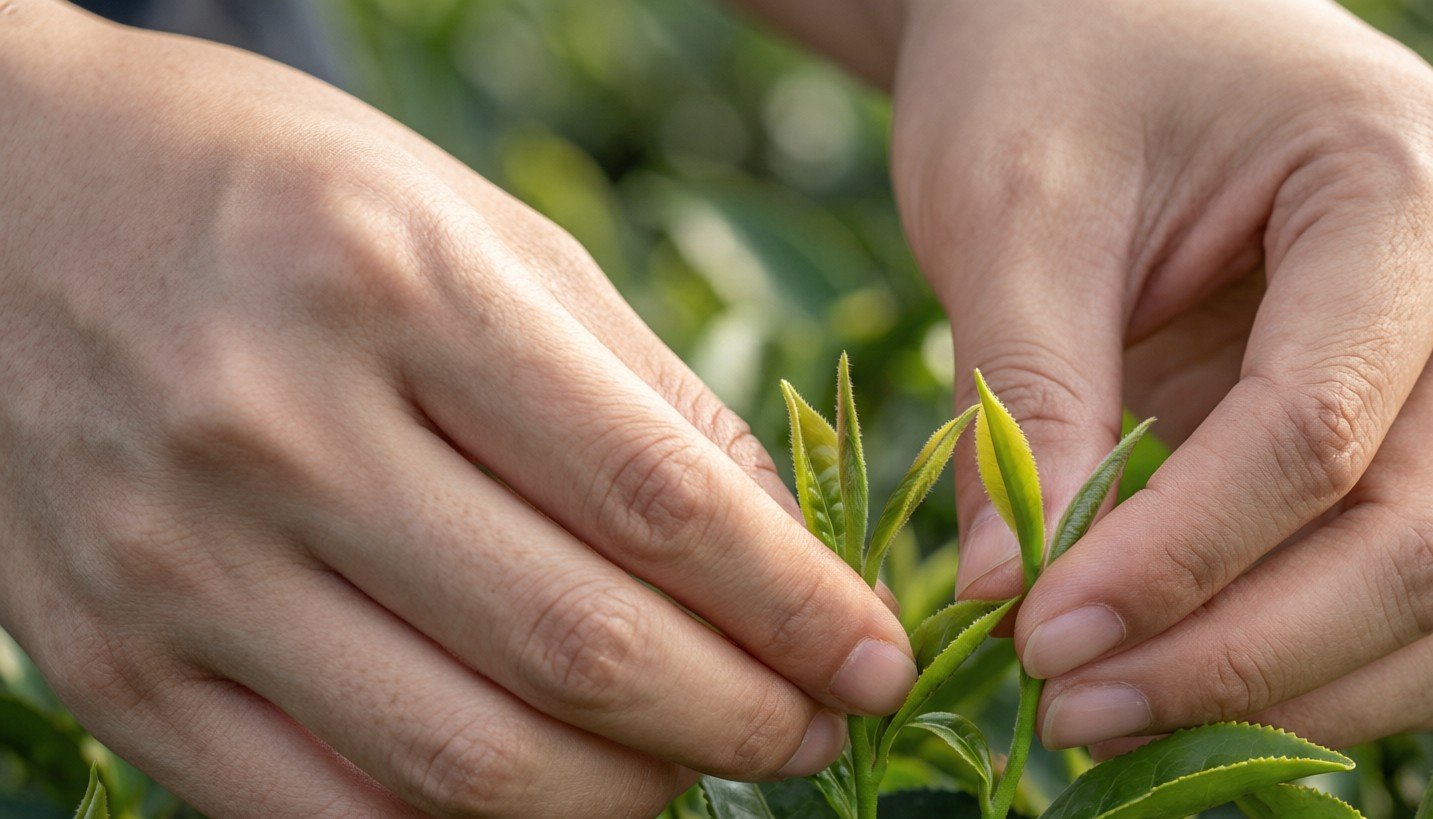
Hand-picking is important because the leaves must remain intact enough for controlled bruising. Machine-harvested leaf can work for lower-cost commercial oolong, but it tends to create more uniform damage, which reduces the processor's ability to control oxidation.
Step 2: Withering
Fresh leaves are spread out to lose moisture. Withering can take place outdoors under indirect sunlight or indoors in climate-controlled rooms. The goal is to soften the leaf, reduce moisture content and begin concentrating aromatic compounds. This stage also starts some early chemical changes that prepare the leaf for oxidation.
Withering is usually a low-temperature, humidity-controlled process. If the leaves wither too quickly, they can dry unevenly and become brittle. If they wither too slowly, bacterial or enzymatic activity can move in the wrong direction. In practice, processors watch leaf texture and aroma rather than relying on a fixed clock.
Step 3: Tossing, Shaking and Bruising
This is the step that makes oolong different from most green and black teas. After withering, the leaves are tossed, shaken or stirred in bamboo baskets, rotating drums or cloth bags. The movement bruises the leaf edges without tearing the entire leaf.
Bruising breaks cell walls in selected areas, exposing polyphenols and enzymes to oxygen. The processor usually repeats the tossing and resting cycle several times. Each cycle deepens oxidation and builds aroma compounds. This stage is sometimes called "yao qing" in Chinese production, and it requires experience because over-tossing produces stewed or sour notes, while under-tossing leaves the tea flat.
Step 4: Controlled Oxidation
After bruising, the leaves rest in a warm, humid environment to allow oxidation to proceed. Oxidation is not the same as microbial fermentation; it is an enzymatic reaction driven by polyphenol oxidase inside the leaf [1][4]. The processor controls time, temperature and airflow to reach the target oxidation level for the intended style.
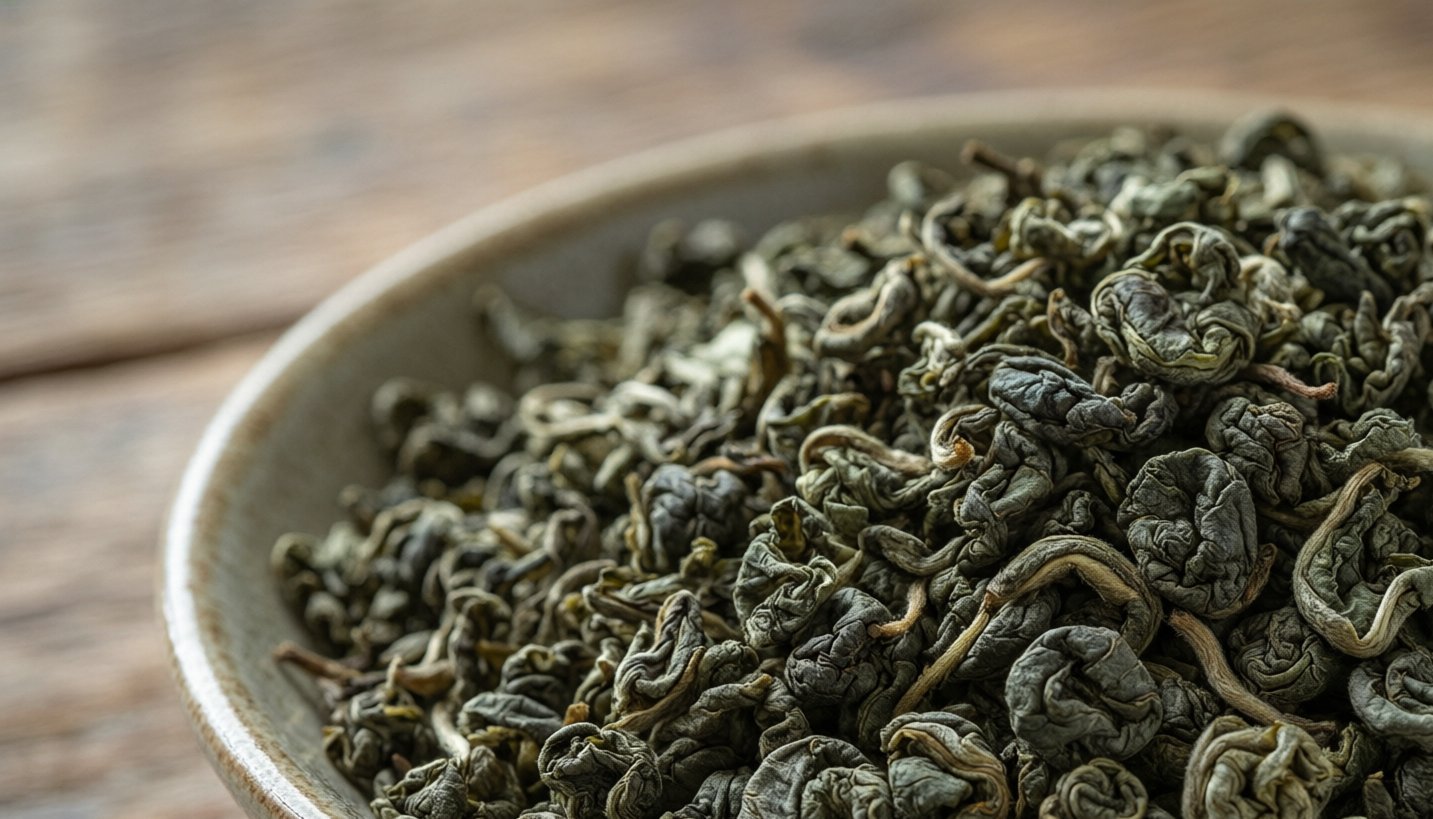
Light oolong styles are generally stopped at a lower oxidation level to preserve floral freshness. Darker styles are allowed to oxidize further before the next step halts the reaction. The exact level is judged by leaf color and aroma: the bruised edges turn reddish while the centers stay greener, producing the characteristic "green leaf with red edge" appearance in many traditional oolongs.
Step 5: Kill-Green
Kill-green, also called fixation or "sha qing," uses high heat to deactivate the enzymes responsible for oxidation. In commercial production, this is done in drums, pans or hot-air systems. The temperature must be high enough to stop oxidation quickly, but not so high that the leaf scorches.
This step locks the oxidation level into place. It also removes grassy, raw notes and begins to develop the tea's foundational aroma. Fixation is one of the most important control points in oolong processing because it decides whether the final tea reads as floral, balanced or roasted.
Step 6: Rolling and Shaping
After fixation, the softened leaves are rolled or shaped. The method depends on the style. Anxi oolong is often tightly rolled into ball-like pellets, while many Wuyi rock teas are twisted into long, slightly curled strips. Taiwanese high-mountain oolong is frequently rolled into compact spheres.
Rolling does more than shape the leaf. It further breaks down cell structure, releases essential oils and improves the tea's ability to extract flavor during brewing. For strip-style oolong, rolling is shorter and gentler. For ball-style oolong, the rolling and re-drying cycle may be repeated several times to create the dense, slow-opening shape.
Step 7: Drying
The rolled leaves are dried to reduce moisture to a stable level. Drying is often done at moderate temperatures in ovens, dryers or heated drums. The goal is to preserve the aroma created during oxidation while stopping further enzymatic change.
Drying also sets the tea's shelf life. If residual moisture is too high, the tea can lose aroma quickly or develop off-flavors during storage. Chinese standards and commercial specifications typically require low final moisture content, which is one reason moisture testing is a routine part of wholesale quality control [2].
Step 8: Roasting and Refining
Many oolong teas receive an additional roasting step after drying. Roasting is especially important for Wuyi rock tea, traditional Tieguanyin and aged or re-roasted oolong styles. It can range from light charcoal or electric baking to repeated high-temperature roasting over weeks or months.
Roasting deepens color, adds caramel, mineral or toasted notes, and increases the tea's stability. Lightly roasted oolong preserves more floral and fresh character; heavily roasted oolong becomes darker, warmer and more durable. The same base leaf can produce very different products depending on roasting intensity, which is why importers often request the specific roast level rather than only the tea name.
Step 9: Sorting, Grading and Packaging
After roasting, the tea is cooled, sorted and graded. Stems, broken leaf and dust are removed to create a uniform particle size. Some oolong is sold as whole leaf with minimal breakage, while other commercial lots are blended for consistency across harvests.
Final packaging is also part of production from a commercial standpoint. Oolong is usually packed in foil-lined bags, vacuum packs or sealed bulk cartons with low oxygen exposure. For ball-style oolong, vacuum packaging helps protect the tightly rolled shape and fresh aroma.
How Oxidation and Roasting Shape the Final Cup
Oxidation and roasting are the two biggest flavor levers in oolong production. Oxidation mainly changes the tea's fruit, floral and body characteristics. Low oxidation tends to produce greener, brighter, more floral or creamy profiles. Higher oxidation adds riper fruit, honey, spice and a heavier mouthfeel.
Roasting works on top of oxidation. A lightly roasted, low-oxidation oolong can taste like fresh flowers and sweet cream. A heavily roasted, high-oxidation oolong can taste like dark honey, minerals, baked fruit or toasted grain. The interaction between these two variables is why two oolong teas from the same region can taste completely different.
For importers, this means the product name alone is not enough. A Tieguanyin can be bright and floral, or it can be charcoal-roasted and dark. A Wuyi rock tea can be medium-roasted and aromatic, or heavily fired and intense. The technical specification should record oxidation level, roast degree, harvest season and cultivar, not only the marketing name.
Regional Oolong Styles and Oxidation Levels
| Oolong Style | Typical Oxidation Level | Common Leaf Shape | Representative Flavor Direction |
|---|---|---|---|
| Anxi Tieguanyin | Low to medium | Tight ball | Floral, creamy, orchid |
| Wuyi rock tea | Medium to high | Twisted strip | Mineral, roasted, honey |
| Guangdong dancong | Medium to high | Twisted strip | Intense fruit and floral aroma |
| Taiwanese high-mountain | Low to medium | Tight ball | Buttery, floral, smooth |
| Dongding oolong | Medium | Tight ball | Baked, fruity, balanced |
These oxidation ranges are approximate and vary by producer, season and roast. They are useful as buying categories but should never replace a physical sample.
What Wholesale Buyers Should Check
A reliable oolong lot should be evaluated for more than dry-leaf appearance. Buyers should check the leaf standard, uniformity, moisture level, roast consistency and how the tea performs across multiple infusions. A high-quality oolong usually opens gradually and maintains flavor through several brews, while lower-quality tea often extracts quickly and fades.

For example, when comparing a light Anxi Tieguanyin with a heavily roasted Wuyi rock tea, the first may be judged on freshness and clarity of aroma, while the second is judged on depth and finish. That is why a single cupping score is less useful than a specification sheet that matches the tea's intended style.
If you are planning to import oolong tea, request samples from the same grade and roast level you intend to order, and confirm the final moisture content and packaging before shipment. For direct sourcing support, contact Chinese tea suppliers at xuansc2144@gmail.com and ask for current production samples, grade options and wholesale pricing.
Work With a Chinese Oolong Tea Supplier
Chinese tea suppliers works with buyers to source Anxi, Wuyi, Guangdong and Taiwanese-style oolong in bulk formats. The team can arrange sample sets, factory cupping notes, moisture testing and packaging options for wholesale orders.
To discuss your target flavor profile, oxidation level, roast degree and volume, contact Chinese tea suppliers at xuansc2144@gmail.com. Include your destination market, preferred leaf style and estimated monthly quantity so the team can recommend the most suitable production lots.
Frequently Asked Questions
What is the difference between oolong tea and black tea?
Oolong tea is partially oxidized, while black tea is fully oxidized. The production process for oolong stops oxidation at a chosen point through kill-green, whereas black tea is allowed to oxidize to completion before drying [1]. This gives oolong a wider range of fresh, floral and roasted profiles.
Does oolong tea undergo fermentation?
Traditional oolong tea primarily undergoes enzymatic oxidation, not microbial fermentation. The term "fermentation" is often used informally, but the main chemical change during tossing and resting is driven by polyphenol oxidase reacting with oxygen [4]. Some aged or post-fermented teas can involve microbial activity, but this is not part of standard oolong processing.
Can oolong tea be aged?
Some oolong styles, especially heavily roasted Wuyi rock tea and traditional Tieguanyin, can be re-roasted and stored for extended periods. Over time, the roast character softens and the tea can develop smoother, more medicinal or herbal notes. Light, low-oxidation oolong is usually consumed fresh and does not improve with long-term storage.
How long does oolong tea stay fresh?
Sealed, low-moisture oolong can retain good flavor for 12 to 24 months under cool, dry, dark storage. Light, floral styles are more sensitive to oxygen and aroma loss. Heavy-roasted oolong is generally more stable and can hold character longer when properly stored.
Which oolong tea is best for wholesale or import?
There is no single best oolong for every market. Light, floral styles often perform well in specialty retail and modern tea markets, while roasted Wuyi and traditional styles appeal to buyers looking for depth and tea culture. The better question is whether the supplier can match a clear oxidation, roast and leaf-grade specification to your target customer.
References
[1] International Organization for Standardization, ISO 20715:2023, Tea — Classification, 2023.
[2] Standardization Administration of China, GB/T 30357.1-2013, Oolong tea — Part 1: Basic requirements, 2013.
[3] Standardization Administration of China, GB/T 14487-2017, Tea vocabulary, 2017.
[4] Food and Agriculture Organization of the United Nations, "Tea: Processing," FAO, 2024.
No author description available.

白玉京