West Lake Longjing Brewing: Temperature, Ratio & Timing
West Lake Longjing is one of China’s most famous green teas, but the distance between a sweet, chestnut-like cup and a bitter, vegetal one usually comes down to three variables: water temperature, leaf-to-water ratio, and steep time. For tea buyers who sell Longjing, getting these numbers right also reduces customer complaints and makes the product easier to train staff on.
Why West Lake Longjing Needs a Different Approach
West Lake Longjing, or Xihu Longjing, is a pan-fired green tea with flat, sword-shaped leaves and a distinctive combination of fresh chestnut, sweet pea, and orchid notes. The leaves are usually tender early-spring buds, so they are more thermally sensitive than rolled oolong or fully oxidized black tea.
The practical result is that classic black-tea brewing habits—boiling water, long steeps, heavy leaf—damage the cup. Longjing rewards lower heat, a measured ratio, and decanting before the liquor turns astringent [1].
Water Temperature: 80–85°C (176–185°F)
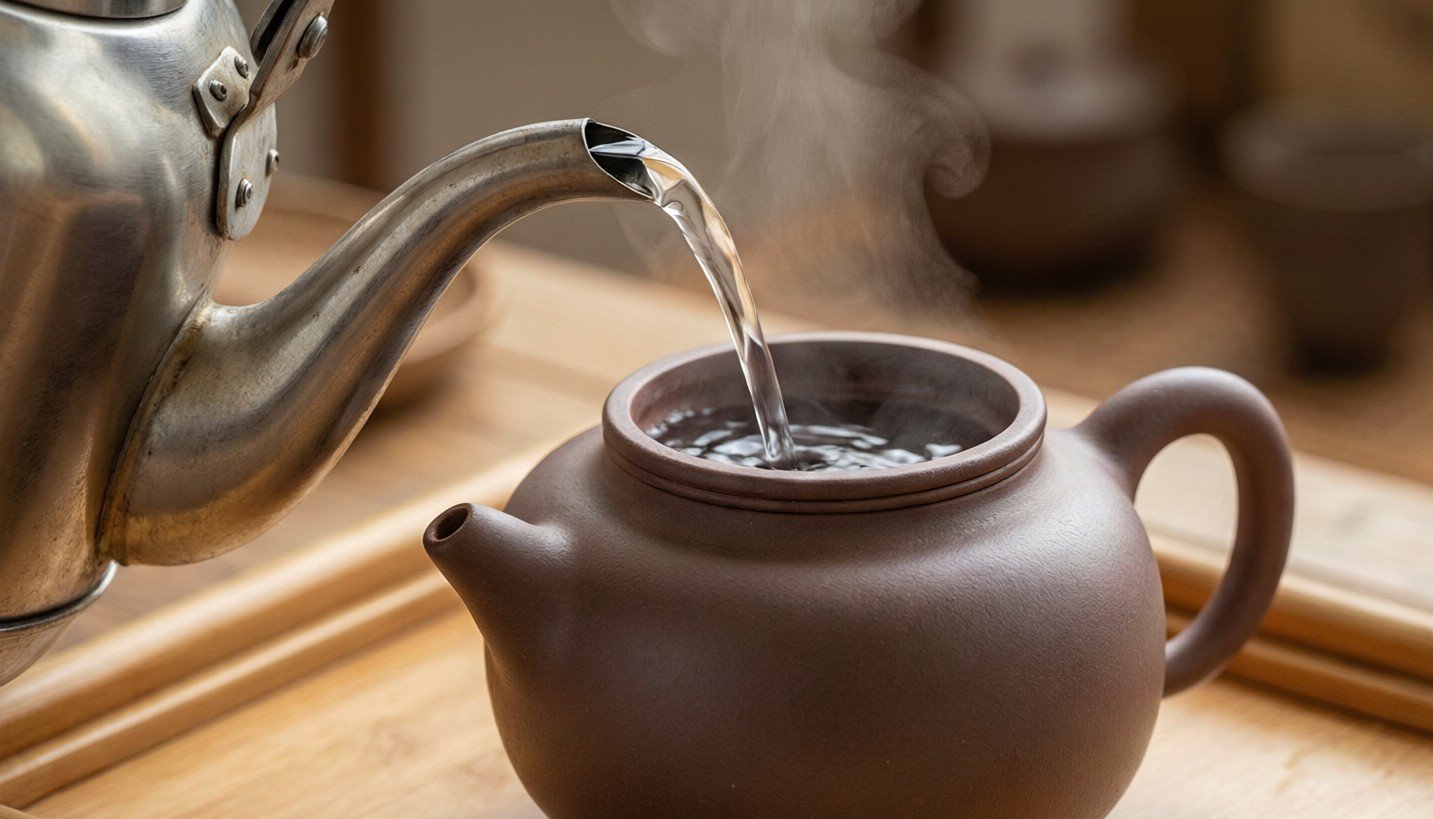
For high-grade West Lake Longjing, start with water at 80–85°C. That is about 176–185°F, or water that has stopped rolling after a full boil and sat for roughly one to two minutes.
Boiling water extracts catechins and polyphenols too quickly, which is why a 100°C pour can turn a delicate first-flush Longjing sharp and yellow-green. At 80–85°C, the amino acids that create Longjing’s sweet, brothy texture dissolve effectively while the more astringent compounds stay in better balance [3].
If you do not have a temperature-controlled kettle, use this simple method: bring water to a full boil, pour it into a cooled fairness pitcher or open cup first, then pour from that vessel onto the leaves. This drops the temperature into the working range without measuring.
Leaf-to-Water Ratio: Match the Vessel
There is no single ratio that works for every brewing vessel, but the starting points below are practical for most professional tasting and retail use. The 1:50 ratio—3 g of dry leaf per 150 mL of water—is a common sensory-evaluation baseline and aligns with standardized tea-liquor preparation methods [2][3].
| Brewing method | Dry leaf | Water volume | First steep | Later steeps |
|---|---|---|---|---|
| Gaiwan or small glass | 3 g | 150 mL | 15–25 seconds | Add 5–10 seconds each round |
| Western teapot or mug | 2–3 g | 250 mL | 2–3 minutes | 3 minutes, then reduce leaf or stop at two steeps |
| Cold brew, still | 4–5 g | 500 mL cold water | 6–8 hours in refrigerator | One extraction |
For retail customers, a safe universal instruction is 2.5 g per 200 mL of water at 82°C, steeped for two minutes. It is slightly leaner than gongfu style, but it is forgiving and rarely turns bitter.
Steep Timing: Shorter Than Most People Think
Longjing does not improve with a prolonged first steep. In a gaiwan, 15–25 seconds is usually enough to release aroma, sweetness, and the early chestnut note. The second and third infusions can be slightly longer because the leaf expands and releases flavor more slowly after the initial surface extraction.
In a Western teapot, keep the first steep to two to three minutes and always decant fully. Leaving leaves sitting in water between cups is the fastest way to create the bitter cup that consumers often mistake for poor-quality tea.
Step-by-Step Brewing Method
Glass method
- Warm a tall glass with hot water, then empty it.
- Add 3 g of West Lake Longjing.
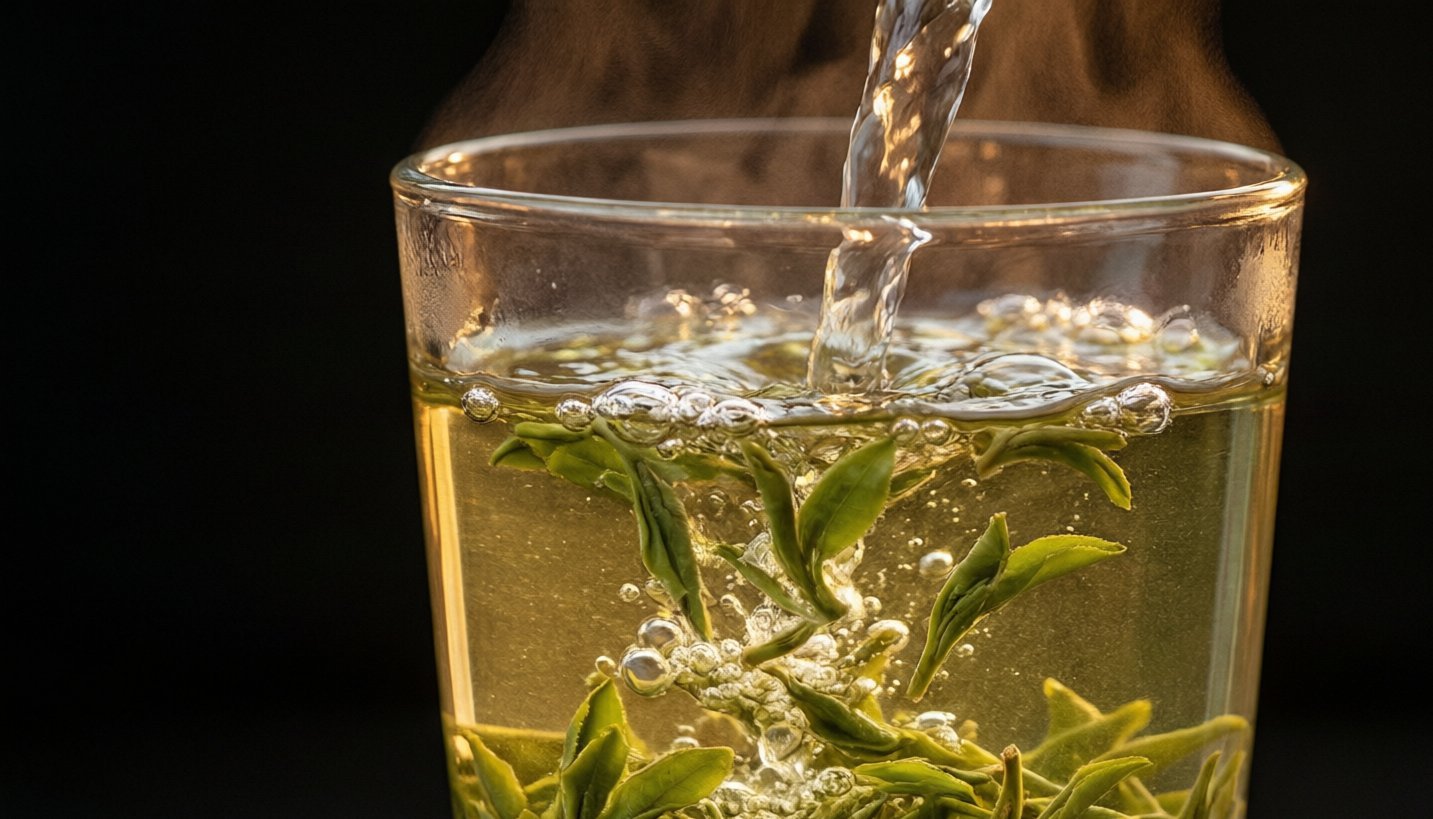
- Pour 80–85°C water down the side of the glass until about one-third full.
- Let the leaves wet and open for 20 seconds.
- Fill to 150 mL and steep for another 15–20 seconds.
- Drink directly from the glass or decant into a fairness pitcher.
Because Longjing is flat and light, many drinkers prefer the glass method: the leaves stand upright, release aroma, and remain visible. The visual issue matters in tea sales—customers often judge quality by leaf uniformity in the glass.
Gaiwan method
- Pre-warm the gaiwan.
- Add 3 g of dry leaf.
- Pour 80–85°C water along the gaiwan wall to avoid directly hitting the leaves.
- Cover and steep 15 seconds.
- Pour out completely.
- Repeat, adding 5–10 seconds per infusion.
A cleanly decanted gaiwan brew preserves the top notes for three to four rounds, after which the liquor becomes sweeter and softer.
Five Mistakes That Flatten Longjing
- Boiling water. Temperature above 90°C extracts too much bitter polyphenol too early.
- Too much leaf. More leaf does not mean more flavor—it usually means more astringency.
- Leaving the leaves in the water. Always decant after the intended steep.
- Using a cold cup. Always pre-warm the vessel; otherwise the first steep loses heat immediately.
- Storing the opened tea badly. Longjing is a fresh green tea. Heat, light, air, and moisture flatten its aroma within weeks.
Calibrating Brew Specs for Your Longjing Grade
Not every West Lake Longjing behaves identically. Early-spring bud-heavy lots often need slightly lower temperature, while later-picked or more roasted lots can accept 85°C. If you are building brew instructions for a private-label retail pack or a café menu, the most reliable approach is to fix one variable at a time: keep the ratio constant, then test the same lot at 78°C, 82°C, and 85°C.
Suppliers can help by providing lot-specific guidance. Contact Chinese tea suppliers at xuansc2144@gmail.com with your target format—gaiwan, teapot, or cold brew—and request a brew spec tied to the exact grade you are buying.
Source West Lake Longjing with Brewing Data Included
For importers, private-label brands, and foodservice buyers, the most useful Longjing shipment includes more than leaf: it includes the extraction window that matches the grade.
When you inquire with Chinese tea suppliers, specify:
- Whether you want pre-Qingming or later-harvest Longjing.
- Your primary brewing format: gaiwan, glass, teapot, or RTD extraction.
- Your customer base: retail drinkers, cafés, hotels, or bottled tea production.
- Your target cup profile: sweet and light, full-bodied, or cold-brew friendly.
Email xuansc2144@gmail.com with “Longjing brew spec” in the subject line, and include the four points above. That lets the supplier match the leaf grade to the temperature, ratio, and time your customers will actually use.
Frequently Asked Questions
Why should Longjing use 80–85°C instead of boiling water?
Boiling water extracts bitter polyphenols too fast. A lower temperature keeps the cup sweet, brothy, and balanced while still releasing the characteristic chestnut aroma.
What ratio should I use in a gaiwan versus a teapot?
Start with 3 g of leaf per 150 mL in a gaiwan and 2–3 g per 250 mL in a Western teapot. The shared starting point is close to 1:50; adjust up or down after tasting the first cup.
How many infusions can West Lake Longjing give?
In a gaiwan, a high-grade lot usually gives three to four pleasant infusions. In a Western teapot, expect two solid steeps if you decant fully each time.
Do I need to rinse Longjing leaves?
No. Unlike many oolong or pu-erh teas, premium Longjing is not improved by a rinse. A rinse removes some of the early sweetness. Use the first infusion directly.
Does water quality really change the flavor?
Yes. Soft or filtered water with moderate mineral content usually produces a rounder, sweeter cup. Hard water can mute the floral top notes and make the tea taste flat or chalky.
How should I store Longjing after opening?
Keep it in an airtight, opaque container away from heat, light, and moisture. Refrigeration can help if the sealed package is allowed to return to room temperature before opening, but do not store open tea in a humid refrigerator.
References
[1] GB/T 18650-2008, Product of geographical indication — Longjing tea, Standardization Administration of China, Beijing, 2008.
[2] ISO 3103:1980, Tea — Preparation of liquor for use in sensory tests, International Organization for Standardization, Geneva, 1980.
[3] M.L. Heiss and R.J. Heiss, The Tea Enthusiast’s Handbook: A Guide to the World’s Best Teas, Ten Speed Press, 2010.
No author description available.

白玉京