Real vs Fake White Tea: A Buyer’s Test for Importers (7 Checks)
White tea is one of the most subtle and most frequently mislabeled categories in specialty tea. Because processing is minimal and dried leaves can look quiet and uniform, it is relatively easy for low-grade green tea, old stock, or leaves from another province to be passed off as fresh Fuding or Zhenghe white tea. The financial risk is concentrated in exactly the lots buyers think are the safest: early spring silver needle, high-grade white peony, and "fresh picking" offers.
This buyer's test gives you a repeatable screening process before you commit to a sample payment, a deposit, or a container order.
Why White Tea Gets Counterfeited
White tea has two features that invite fraud. First, authentic white tea demands specific raw material and patient withering. Genuine high-grade Fuding white tea is not cheap to make, and the best batches come from a narrow harvest window. That creates a gap between what buyers expect to pay and what authentic material actually costs.
Second, the dry appearance of white tea is harder for a new buyer to judge than green tea or oolong. There is no roasted shine, no rolled shape, and no intense floral aroma to signal quality at first glance. That allows sellers to label older leaf, borderline leaf grades, or even re-processed tea as fresh white tea.
The Seven-Part Buyer's Test
Run these checks in order. No single check is enough on its own, but three or more failures should stop the order.
1. Check the Origin Claim Against the Reality of Chinese White Tea
Traditional Chinese white tea is concentrated in Fujian's eastern and northern tea-growing belt: Fuding, Zhenghe, Jianyang, Songxi, and a few neighboring counties. If a supplier says "Fuding white tea" but cannot identify the village, township, processing date, or factory, treat the origin claim as unproven.
Other provinces do make white-style teas. Yunnan produces moonlight white, and several regions now make white tea from local cultivars. These can be legitimate products, but they should be sold under their own regional names, not passed off as Fuding or Zhenghe material.
A meaningful packet or offer should include at least a production area, harvest season, cultivar, and grade. If the source is either completely generic or shifts from "Fuding" to "Yunnan" when you ask for documents, that is a red flag.
2. Read the Grade and Standard Label on the Sample
Under China's national white tea standard GB/T 22291, white tea is classified by leaf standard and processing, not merely by age or color [1]. The main commercial grades are:
| Grade | Typical Material | Appearance Signal |
|---|---|---|
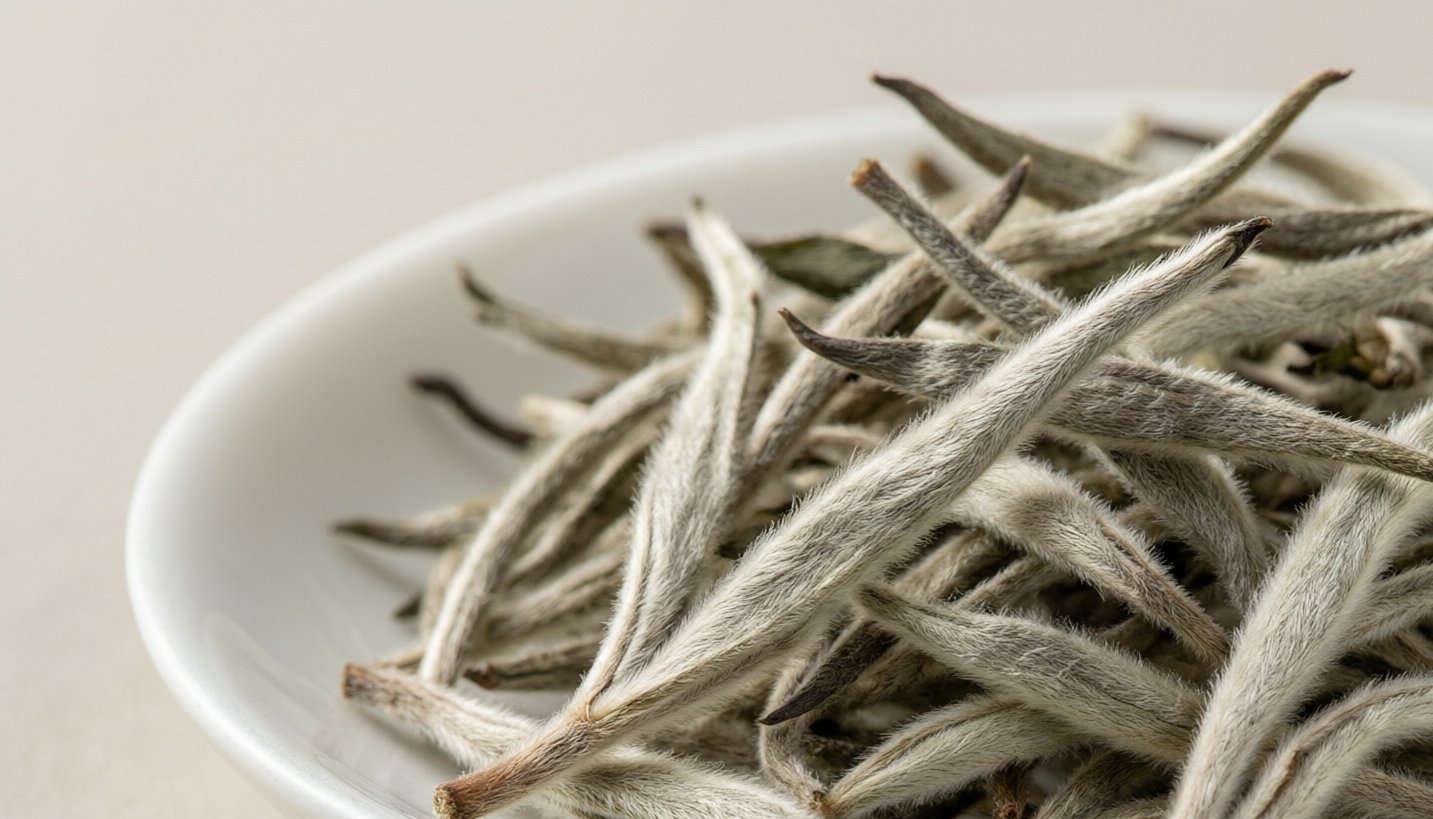
| Baihao Yinzhen / Silver Needle | Single buds only | Covered in fine white down; uniform bud shape |
| Baimudan / White Peony | One bud plus one or two young leaves | Gray-green leaves with visible white down; intact structure |
| Gongmei | More mature small leaves | Mixed color, thinner leaves, more visible stem |
| Shoumei | Larger, more open leaves | Coarser leaf, fragmented but not uniformly chopped |
A lot that is labeled silver needle but contains many separated leaf fragments is mislabeled even if some buds are present. A lot sold as white peony should not look like a broken green tea or a tightly rolled oolong.
3. Inspect the Dry Leaf for Shape, Color, and Breakage
Fresh, correctly dried white tea should look naturally withered. The best material stays light and open. It is not rolled into tight balls, not twisted into thin strips, and not chopped into uniform pieces as though it came from a machine-cut tea bag line.
For silver needle, check the down. Authentic high-altitude or early season material has abundant white fuzz covering the bud. Re-processed or old material may appear shiny, flattened, brownish, or strangely green. Be wary of any lot that looks too bright and uniform; that can indicate added coloring or heat treatment to make older leaf look fresher.
4. Brew It: Liquor, Aroma, and Mouth Feel
The liquor reveals what the dry leaf hides. Fresh white tea generally infuses to a pale apricot, light gold, or champagne yellow color, with a soft, slightly sweet aroma of fresh hay, melon, honey, or light flowers. It should feel smooth in the mouth, with mild astringency and a lingering sweet aftertaste.
Be suspicious if the liquor brews aggressively green and vegetal like a fresh spring green tea, or brown and woody like an old leaf. A bitter, thin, or flat-tasting cup on the first infusion is a warning, as is an aroma that smells smoky, burnt, sour, or artificially perfumed [2].
Use a neutral tasting setup: ceramic gaiwan or porcelain cupping set, 5 grams of leaf, 150 ml of water at roughly 90°C. Steep for 30 to 60 seconds and repeat at least three times. This is the simplest reproducible way to compare a proposed sample against a known reference batch.
5. Verify the Paperwork Before the Price Conversation
Request the batch-specific third-party test report for pesticide residues, moisture, and total ash. Generic company PDFs are not enough. The report should be dated, linked to a lot number or invoice line, and issued by a laboratory that can be independently identified. For shipments into the EU or US, use the seller's readiness to share current MRL-related test results as a screening question [2][3].
Origin documentation should align with the physical leaf, not merely match the offer sheet. If the shipping mark, production date, harvest season, and grade do not line up across the label, lab report, and factory statement, ask for the discrepancy to be corrected before sampling.
6. Apply a Price and Volume Sanity Check
Fresh white tea is priced as a seasonal agricultural product. The window for early spring silver needle is short, and genuine material moves quickly. If a seller offers unlimited volume at a stable low price across the entire year, the offer is likely blended, re-processed, or built from later and lower grade leaf.
Compare price by grade, not by the generic word "white tea." Compare Fuding silver needle with another Fuding silver needle, not with a lower grade from a different region. When one supplier's price is far below the rest for the same claimed grade and season, the load is probably not what the label says.
Need help with a white tea purchase? Send your target grade, volume, and destination port to 427728483@qq.com and we can compare verified Fuding and Zhenghe fresh white tea samples against your current offer.
7. Check Storage Conditions for Fresh Tea Claims
"Fresh tea" does not mean the leaf was picked this morning. It means the tea is from the current or immediately previous production period and has not been allowed to lose too much aroma and moisture. Fresh white tea should still smell clean and lively, not flat or dusty.
If the seller shows a warehouse where white tea is stored in open-top sacks, stacked near a wall, or left in a warm, humid space, the product will age unevenly regardless of its initial quality. Moisture-proof packing, cool storage, and batch-based stock control are relevant to a purchase decision.
Red Flags That Should Stop a Purchase
Several patterns appear repeatedly in mislabeled or fake white tea:
- Labels that say "Fuding style" or "Fuding technique" rather than a place of origin.
- Lots sold as silver needle with an unusually high share of broken leaf and powder.
- Tightly rolled or highly uniform dry leaf in a category that should look loose and naturally withered.
- Prices that stay flat year-round while seasonal supply changes.
- Test reports that are shared only as screenshots or are expired.
- Sellers who become defensive when you ask for the township, harvest date, or re-tasting sample.
How to Structure a Safer Purchase
Start with small, split samples. Ask the supplier to send two or three numbered lots across grades so you can compare them blind. Keep a reference sample of an accepted batch, then compare every future delivery against it. A purchased sample tray, a consistent cupping setup, and a written grading sheet will help you catch change before you expose a full container to risk.
Do not finalize a large order based on a photograph or a single tasting note. The safest pattern is: physical sample, blind evaluation, lab check, then order.
Sourcing Verified Fresh White Tea
You do not need to become a white tea expert in one season to buy safely. The test above gives you a repeatable filter. If you are sourcing multiple grades or comparing current offers, ask for a structured sample set rather than a single best-looking sample.
We supply fresh Fuding and Zhenghe white tea in bulk and retail formats, with grade comparison samples available before you commit. Contact 427728483@qq.com with your target grade, monthly quantity, and destination port for a current sample set and landed-cost quote.
FAQ
What does "fresh tea" mean for white tea?
It refers to tea from the current or immediately previous production period that still has clean, lively character. It is not a guarantee of harvest date. Ask for the production year and storage conditions before relying on the word "fresh."
Can fake white tea be safe to drink?
Not always. The problem may be quality fraud, such as old leaf relabeled as fresh, or it may involve unauthorized additives and pesticide residue. This is why laboratory verification matters alongside visual checks [2][3].
Is silver needle more likely to be fake than shoumei?
Silver needle is more likely to be financially attractive to counterfeiters because the price gap between grades is large. However, shoumei can also be mislabeled, blended, or sold as artificially aged white tea. Every grade needs the same testing discipline.
Should I buy directly from Fuding or through a trading company?
Both can work if the documentation and samples are consistent. A good trading company can consolidate grades and manage logistics; a direct factory can offer stronger traceability. In either case, the batch-level paperwork and repeat samples matter more than the title of the seller.
How can I verify a supplier's white tea is authentic before a bulk order?
Use the seven-part test: verify origin, read the grade label, inspect dry leaf, brew it under neutral conditions, check the lab report, compare price by grade, and review storage. A supplier that cooperates with all seven steps is a stronger candidate than one that refuses any single check.
References
- Standardization Administration of China. GB/T 22291, White Tea. Beijing: Standards Press of China.
- European Commission. RASFF Food and Feed Safety Alerts. https://webgate.ec.europa.eu/rasff-window/screen/search (accessed 2026).
- U.S. Food and Drug Administration. Import Alert 99-08: Detention Without Physical Examination of Tea. https://www.accessdata.fda.gov/cms_ia/importalert_27.html (accessed 2026).
No author description available.

白玉京