Real vs Fake Liu Bao Tea: Tests Buyers Can Actually Use
Liu Bao tea is one of the easiest Chinese dark teas to counterfeit. The leaves are not visually dramatic, most new buyers have no reference benchmark, and age claims are difficult to verify. As a result, origin substitution, age inflation, and re-labeled generic Guangxi heicha are common in wholesale offers. This guide gives you a repeatable way to separate authentic Liu Bao tea from imitations before you commit to a container.
Start With the Benchmark: What Real Liu Bao Tea Is
Real Liu Bao tea is a post-fermented dark tea from the Cangwu/Wuzhou tea districts of Guangxi. Its traditional form is loose or lightly compressed tea aged in bamboo baskets rather than a tightly pressed factory disc. The tea moves through initial kill-green, rolling, pile fermentation or steaming, and long post-fermentation aging.
The Chinese national standard for Liupao dark tea sets the product definition, sensory requirements, physicochemical parameters, and safety rules [1]. A lot sold as Liu Bao should be able to show conformity to that standard. If the supplier cannot clearly name the production region and processing method, that is already a red flag.
Authentic Liu Bao tends to present a dark reddish-brown dry leaf, a warm aged-wood or betel nut aroma, and a smooth, earthy liquor with a returning sweetness. Those markers are not proof on their own, but they give you a baseline before testing.
Four Ways Fake Liu Bao Tea Appears
Most fake Liu Bao falls into one of these patterns:
- Origin substitution: Dark tea made in Hunan, Guangdong, or another Guangxi county is packed in Liu Bao wrappers. After fermentation, the dry leaf can look close enough to fool a screen-based buyer.
- Age inflation: Young or mid-fermented tea is wet-stored, steamed, or sprayed to darken quickly, then sold as 8-, 12-, or 15-year material.
- Category substitution: Generic post-fermented dark tea is marketed as Liu Bao simply because it is dark, earthy, and somewhat aged.
- Blending and re-labeling: A small percentage of real Liu Bao is blended into cheaper dark tea to support a false label and inflate the asking price.
Dry Leaf, Color, and Aroma: The First-Pass Tests
| Check | What genuine Liu Bao tends to show | What should make you pause |
|---|---|---|
| Dry leaf color | Dark brown to black with a natural reddish-brown tone; some variation and visible stem | Uniform oily black, suspected dye, or bright green leaves mixed in |
| Dry aroma | Aged wood, betel nut, camphor, old paper, or warm straw | Burnt sugar, soy sauce, artificial sweetness, chemicals, or sharp sourness |
| Touch | Dry to the touch; leaves break cleanly | Damp, sticky, greasy, or leaves leave color on your fingers |
| Packaging | Batch label, factory name, production date, or basket marking | No production date, no factory, and only vague phrases like “premium aged tea” |
A single failing row is not always decisive, but two or more failures should stop the evaluation.
Liquor, Taste, and Infusion Endurance: The Real Test
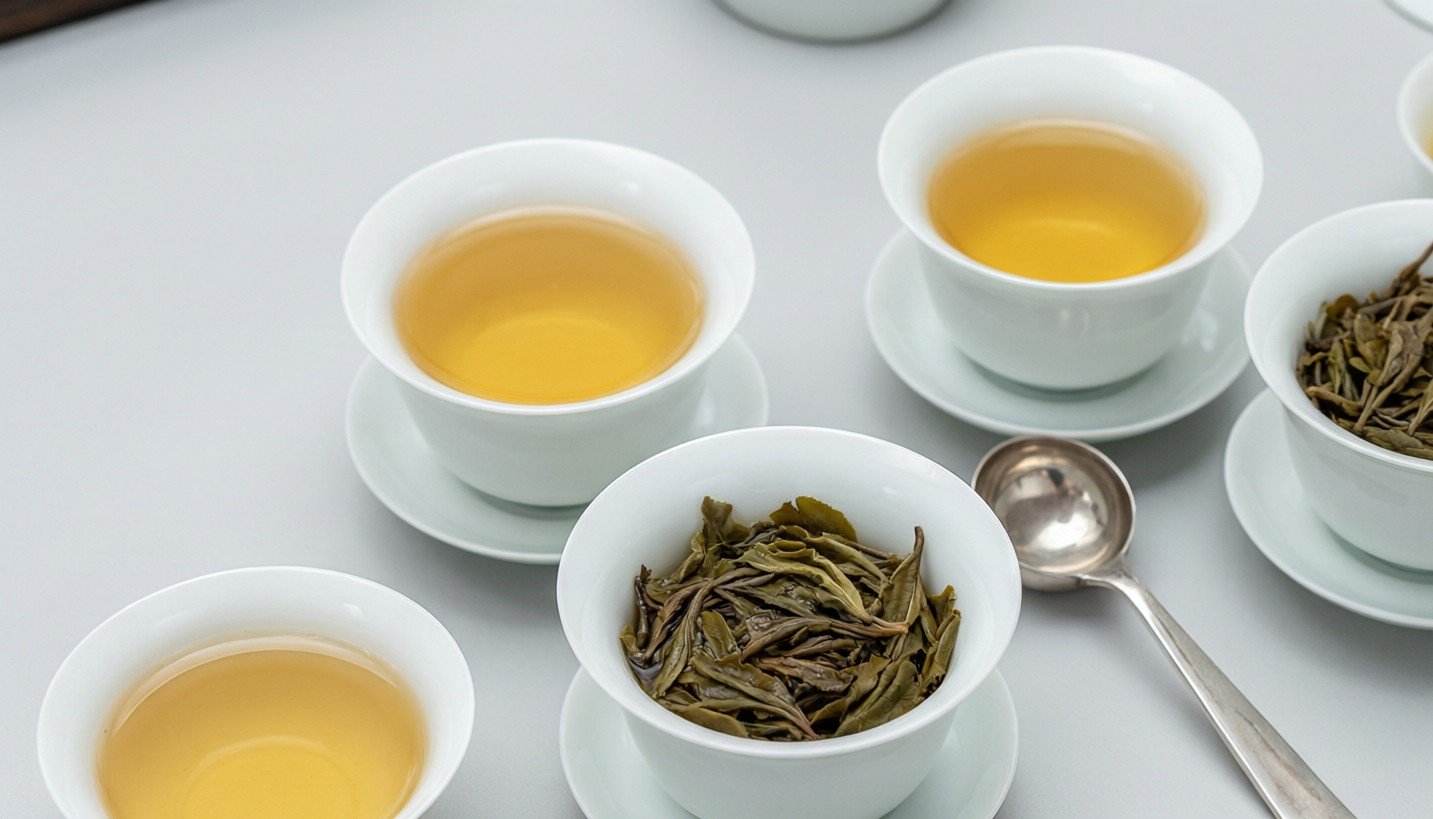
Set the same session for every sample: same water temperature between 95–100°C, same vessel, and the same leaf-to-water ratio. Many buyers use 5 g of leaf per 100 ml of water and a quick rinse before the first evaluation. For a neutral standard preparation, ISO 3103 provides a recognized method [2].
What to compare:
- Liquor color: Good aged Liu Bao brews a clear deep red-brown to amber liquor. Younger material may be orange-red; older material darkens. Imitations often look muddy, brownish-green, or an artificial instant dark red.
- Wet-leaf aroma: Real Liu Bao has a warm fermented aroma with wood, betel nut, or camphor notes. A fake often smells sour, rancid, or like wet cardboard.
- Mouthfeel: The real tea is usually smooth and thick with a returning sweetness. Dominant bitterness or harsh astringency is a warning signal.
- Infusion endurance: True Liu Bao often holds through eight or more infusions. Many imitations flatten by the fourth. This is not a guarantee, but it is a strong practical signal.
Paperwork and Lab Verification
Sensory testing catches obvious fakes, but it does not prove origin, safety, or age. Before you pay, ask for a batch test report that matches the lot number, production date, and net weight. The report should cover pesticide residues [4], mycotoxins including aflatoxin [3], and heavy metals [5]. For export lots, compare those results against the destination market’s Codex or national limits [6].
Also request a certificate of origin and a traceability record naming the production county and factory. If the tea is sold as Wuzhou Liu Bao, ask for evidence linking the lot to a recognized Liu Bao production area under the relevant Chinese standard [1].
Treat age as a claim, not a fact, unless the supplier can provide dated storage records, purchase invoices, or a verifiable factory archive. Without documentation, pay for the tea in front of you rather than the story around it.
Working through a current offer? We can send reference samples of Liu Bao tea at different age bands, with batch reports, so you have a benchmark before you buy. Contact 427728483@qq.com.
The Side-by-Side Cupping Protocol
Use this sequence when comparing candidate lots:
- Blind-label three to five samples, including one known reference if you have one.
- Use 5 g of leaf per 100 ml of water with a quick rinse, then evaluate at 20, 30, 45, and 60 seconds.
- Score each sample on liquor color, aroma, taste, aftertaste, and infusion endurance.
- Inspect the wet leaves after the session for even fermentation, intact structure, and natural reddish-brown color.
- Request full documentation for any candidate that scores well before signing the purchase order.
When to Walk Away
Walk away if the supplier:
- Refuses to provide a batch lab report.
- Cannot name the production area or processing method.
- Claims old age but offers no storage records or dated proof.
- Quotes an aged Liu Bao price far below market for the stated age.
- Shows paperwork identifying another tea region or dark tea category.
A low price is not a proof of failure, but an undocumented age claim at a very low price almost always means the lot is something other than what the label says.
Get a Second Opinion on a Liu Bao Lot
Send the dry-leaf photo, brewed liquor photo, and the supplier’s test report to 427728483@qq.com, or request our current Liu Bao samples with storage records and conformity documents before you commit.
Frequently Asked Questions
What is the difference between Liu Bao tea and Pu-erh?
Liu Bao is a Guangxi dark tea, traditionally steamed, fermented, and often kept in bamboo baskets or loose form. Pu-erh comes from Yunnan and is more commonly pressed into cakes, bricks, or tuos. Both are post-fermented and aged, but the leaf base, production area, processing detail, and flavor profile differ.
Does real Liu Bao tea have golden flowers?
Golden flowers are more strongly associated with certain Hunan dark teas such as Fu Zhuan, where their presence can be a controlled fermentation marker. On Liu Bao, golden flowers are not a standard quality indicator, and any visible mold should be examined before purchase.
How can I verify an aged Liu Bao claim?
There is no reliable shortcut. Ask for dated purchase records, storage logs, batch records, and a matching test report. Sensory comparison against known reference samples can indicate age, but only documentation supports the claim.
What paperwork should I request before importing Liu Bao tea?
Request a batch test report covering pesticide residues, mycotoxins, and heavy metals; a certificate of origin; a phytosanitary certificate; and a supplier conformity statement against the relevant Chinese Liu Bao standard [1] when that claim is made.
Can fake Liu Bao tea still be safe?
It can be safe in the narrow food-safety sense and still be commercially fake. The buyer’s real risk is overpaying for an origin or age claim that cannot be verified. Some counterfeit material also fails safety limits, which is why lab reports matter.
References
[1] Standardization Administration of China. GB/T 32719.5-2018, Dark tea — Part 5: Liupao tea. 2018.
[2] International Organization for Standardization. ISO 3103:2019, Tea — Preparation of liquor for use in sensory tests. 2019.
[3] National Health Commission of the People’s Republic of China. GB 2761-2017, National Food Safety Standard — Limits for mycotoxins in foods. 2017.
[4] National Health Commission of the People’s Republic of China. GB 2763-2021, National Food Safety Standard — Maximum residue limits for pesticides in food. 2021.
[5] National Health Commission of the People’s Republic of China. GB 2762-2022, National Food Safety Standard — Limits of contaminants in foods. 2022.
[6] Codex Alimentarius Commission. General Standard for Contaminants and Toxins in Food and Feed, CXS 193-1995. FAO/WHO.
No author description available.

白玉京