Pan-Fired Tea Processing Explained: What It Is and Isn’t
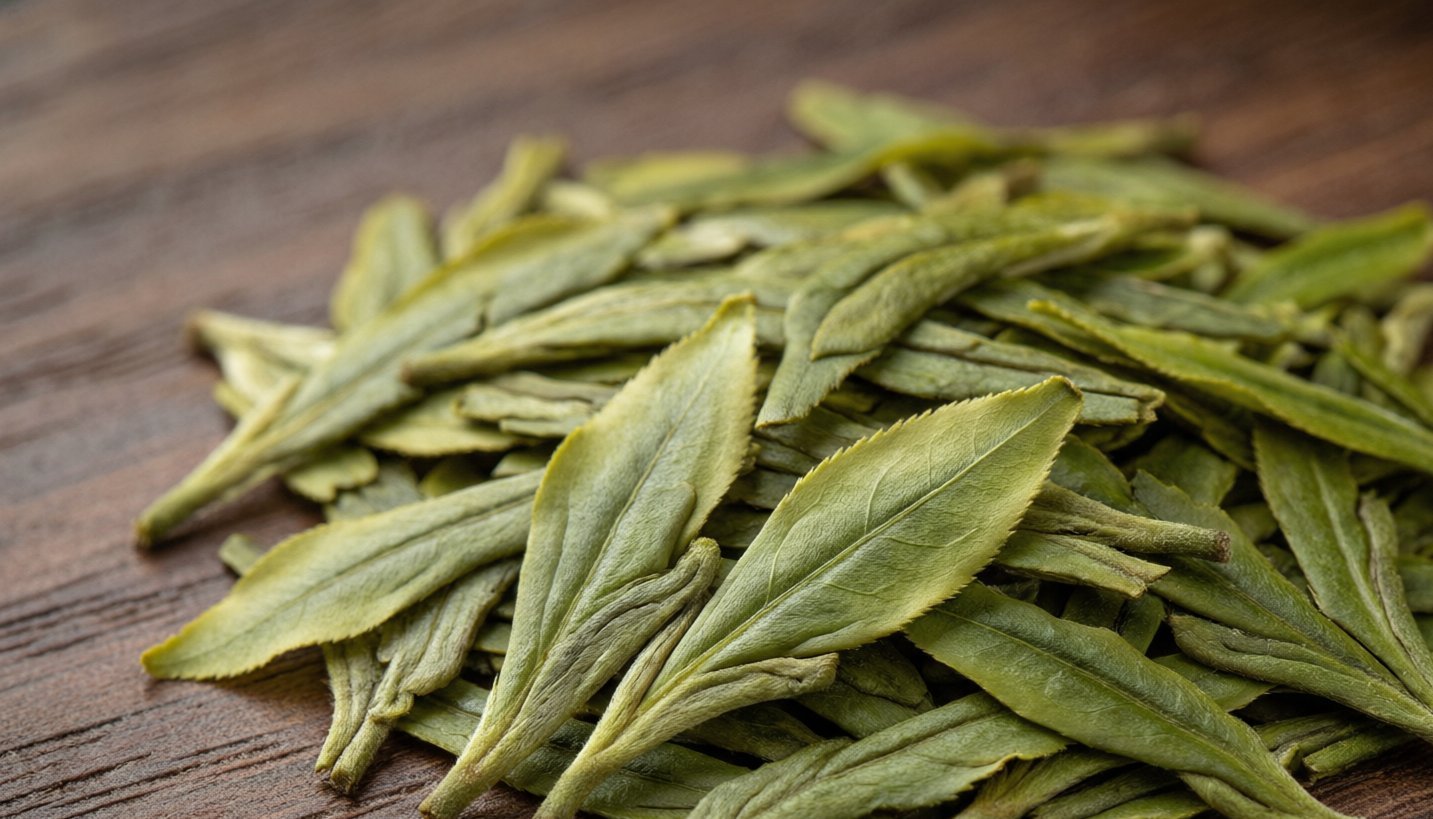
Pan-fired tea is not a tea type, a brand, or a regional trademark. It is a processing decision. In Chinese tea production, the term refers to a dry-heat step called kill-green — shā qīng in Mandarin — in which fresh leaves are heated quickly to stop enzymatic oxidation. The wok, drum, or rotating metal surface does the work that steam does in many Japanese green teas, and that simple difference changes the leaf’s flavor, aroma, storage behavior, and wholesale grade.
If you are a buyer, importer, or retail category manager, “pan-fired” is more useful when treated as a quality variable than as a label. It does not guarantee a smoky tea, a specific flavor, or a premium grade. It does, however, tell you what the producer chose to do in the first phase of heating.
The Term Lives in Processing, Not in the Tea Name
Green tea is defined broadly by a fixation step that halts oxidation shortly after harvest [1]. Chinese green tea standards describe this as a necessary part of green tea processing, but they do not require every green tea to be pan-fired [2]. Some Chinese green teas are steamed, some are baked, and many pass through more than one heating method before they are finished.
Pan-fired specifically means that the leaves are fixed by contact with a heated metal surface. The producer moves, turns, or tosses the leaves to prevent scorching. In the tea trade, this is also called chao qing, or “fired green.” The English term “pan-fired” is sometimes used loosely, which creates exactly the kind of confusion buyers should avoid: a tea can be pan-fired during fixation and then lightly roasted during the drying phase, and still be sold simply as “pan-fired green tea.”
Fixation Is the Actual Job
Fresh tea leaves contain polyphenol oxidase and other enzymes. If the leaf is left intact after picking, those enzymes begin breaking down catechins and browning the leaf. Fixation denatures the enzymes quickly enough to preserve green tea’s color and fresh character [3].
The process is not about cooking the leaf. It is about inactivation. If the heat is too low or too brief, the tea will develop reddish edges, grassiness, or oxidized notes. If the heat is too high or the leaf is not moved fast enough, the tea will taste burnt or metallic. Skilled pan-firing balances heat, time, leaf amount, and movement. That is why two batches from the same garden and the same harvest can cup very differently.
For buying teams, this means “pan-fired” is not a quality certificate by itself. It is a point of control. The useful question is not “Is this tea pan-fired?” but “How well was the fixation executed, and what evidence do I have from the dry leaf, liquor, and aroma?”
What Pan-Fired Tea Is Not
The term carries several assumptions that cause buying mistakes.
First, pan-fired tea is not necessarily smoky. Smoke comes from an additional firing source or, in some oolong traditions, a deliberate roasting step. A well-made pan-fired green tea should be clean, not smoky. A smoky note in a green tea is often a defect.
Second, pan-fired tea is not the same as roasted tea. Firing is a rapid, high-temperature enzyme-stop; roasting is a slower, aromatic drying or finishing step. They can coexist, but they are not interchangeable.
Third, pan-fired tea does not have one flavor. The result depends on cultivar, harvest time, leaf size, wok temperature, toss speed, and the operator’s habit. Longjing often shows a chestnut or bean-like note; some Biluochun lots lean floral and sweet; a high-fired batch of the same garden may taste toasty or dry.
Fourth, pan-firing is not exclusive to green tea. Fixation or shaping by hot metal surfaces also appears in parts of yellow tea and oolong production, although the downstream steps differ sharply.
Fifth, “pan-fired” does not prove the tea is high quality. A low-grade summer leaf can be pan-fired poorly and marketed on the term. Grade must be verified through the leaf set, not the processing vocabulary.
Where Pan-Firing Appears Across Chinese Tea Types
The most common use is in green tea. Many of the famous Chinese green tea styles sold internationally — Longjing, Biluochun, Huangshan Maofeng, Lu’an Guapian, and others — rely on dry-heat fixation, though their shaping and drying methods differ.
In yellow tea, the kill-green step is often similar to green tea fixation, but the leaves are then wrapped or heaped for a short yellowing phase. In oolong tea, some styles use pan-firing for fixation before rolling and roasting. In each case, the stage matters differently: for green tea, fixation protects freshness; for oolong, it sets the stage for oxidation and later roasting.
The table below summarizes the main fixation approaches a buyer is likely to meet.
| Fixation method | Core process | Typical leaf character | Typical liquor | Aroma profile |
|---|---|---|---|---|
| Pan-fired | Dry heat on a metal surface | Yellow-green or dark green, often tight or shaped | Clear, golden-green to yellow | Nutty, chestnut, toasted vegetable, floral |
| Steamed | Steam heat | Deep green, needle-like or fine | Pale green, slightly cloudy | Marine, grassy, brothy, umami |
| Sun-dried | Low-intensity solar or ambient drying | Variable, often open and less uniform | Pale yellow | Soft, hay-like, sap, dried fruit |
| Roasted/finished | Post-drying heat in an oven, basket, or drum | Darker, often glossy or brittle | Amber to golden | Toasty, caramel, honey, mineral |
If the goal is a fresh, lively green tea for Western retail or food service, the pan-fired profile is usually an easier entry point than steamed tea because its nutty, sweet notes are more familiar than grass or brine.
How Pan-Firing Changes Flavor and Grade
Pan-firing does more than stop oxidation. It also drives off moisture, softens the leaf, and begins the formation of aroma compounds. The “fire aroma” — huǒ xiāng — is a positive quality note in many Chinese teas. Fire aroma is not smoke. It reads as toasted grain, chestnut, or warm sugar. Smoke smells like a fire, and it lingers in the throat.
Buyers should also understand that pan-firing affects the leaf’s visual grade. A properly fired leaf is flexible enough to be shaped without tearing, but dry enough to resist oxidation. The dry leaf should look even in color. Scorched tips, red edges, or white burn spots are signs of uneven heat. Wet or brittle leaves create problems later in transport and shelf life.
For a reference set to compare against, ask for samples from two or three fixation batches of the same lot. This is the fastest way to learn whether the supplier’s “pan-fired” description matches the cup. Contact 427728483@qq.com for pan-fired green tea benchmark samples and current harvest specifications.
What Buyers Should Inspect in Pan-Fired Green Tea Samples
A systematic cupping should start with the dry leaf, then move to aroma, liquor, and wet leaf.
Dry leaf. Check color uniformity, shape, breakage, and stem content. Uneven color often means uneven fixation or mixed harvest material. The leaf should feel dry but not crumble into dust at a light touch.
Aroma. Smell the leaf before and after adding water. The dry nose should be clean and warm, not smoky, sour, or papery. The wet leaf should open into the tea’s expected profile — nutty, floral, chestnut, or sweet — without a burnt note.
Liquor. The tea should pour clear, not turbid. Pan-fired green tea often gives a golden-green or bright yellow liquor. Dull brown or muddy tones suggest oxidation, over-firing, or old material.
Taste. A well-fired tea has a clean entry, a defined sweet or nutty middle, and a dry but not harsh finish. Harsh bitterness is not the same as briskness. If the tea is bitter without sweetness or acidity, look for a better-fired batch before blaming the garden.
Wet leaf. After steeping, the leaves should be uniform, supple, and evenly colored. Red edges or mixed green and brown leaves are red flags.
A Practical Sourcing Checklist for Pan-Fired Tea
Use this checklist when comparing suppliers. It turns the processing term into something measurable.
- Confirm the fixation method and equipment: manual wok, drum, or rotating pan.
- Request the batch number, harvest date, garden or origin, and firing date.
- Ask whether additional roasting or drying follows fixation.
- Check the dry leaf for even color, shape integrity, and burn marks.
- Cup the tea against a control sample at the same weight, water temperature, and steeping time.
- Evaluate the wet leaf for uniform expansion and color.
- Request moisture and pesticide reports where applicable, and compare against the destination market’s import requirements.
If the supplier cannot connect the flavor to a specific fixation decision, treat the term “pan-fired” as marketing, not technical information.
Brewing for Evaluation, Not Just Enjoyment
For cupping pan-fired green tea, use a neutral white or glass vessel, around 3 grams of leaf per 150 milliliters of water, and water that is hot but not boiling. If the water is too hot, even an excellent firing job will taste harsh. If it is too cool, the tea will not open enough to reveal defects.
Steep briefly for the first pass — only enough to read the tea’s structure. Pour, sniff the lid, and taste. The second steep often separates good fixation from poor fixation: a well-fired tea holds its sweetness and shape, while an over-fired tea becomes dry and hollow.
Source Pan-Fired Tea with Confidence
Pan-fired tea is a skill, not a slogan. Before you commit to a wholesale order, compare multiple firing batches, inspect the leaf set, and cup the tea under controlled conditions. That is how you avoid paying for a processing story and instead buy a repeatable product.
Tell us your target format, grade, destination market, and price range. We will help you source pan-fired green tea lots with batch-level firing records, split samples, and export documentation.
Email: 427728483@qq.com
Frequently Asked Questions
Is pan-fired tea the same as roasted tea?
No. Pan-firing is a rapid dry-heat step used mainly to stop oxidation. Roasting is a slower drying or finishing step that adds aroma and color. A tea can be pan-fired and then roasted, but the two terms describe different stages.
Does pan-fired tea always taste smoky?
No. Smoke is usually a defect in green tea or a deliberate note in certain roasted oolong and black teas. A well-made pan-fired green tea should taste clean, nutty, or sweet, not smoky.
Which famous Chinese green teas are pan-fired?
Many mainstream Chinese green teas use dry-heat fixation, including Longjing, Biluochun, Huangshan Maofeng, and Lu’an Guapian. The exact method varies by region and producer.
Is pan-fired tea healthier than steamed tea?
Fixation method is not a reliable indicator of health benefits. Both pan-fired and steamed green teas retain catechins and other bioactive compounds when processed and stored well. The difference is mainly sensory, not therapeutic.
How can I tell if a pan-fired green tea was poorly fired?
Look for scorched tips, uneven dry leaf color, red edges, a burnt or hollow taste, and a dull brown liquor. The wet leaf should be uniform and supple after steeping.
Does pan-firing affect shelf life?
Yes. Fixation quality affects residual enzyme activity and moisture content. A properly fired tea with low residual moisture and intact leaf structure will hold freshness longer than a poorly fired batch.
References
[1] ISO 11287:2011. Green tea — Definition and basic requirements. International Organization for Standardization.
[2] GB/T 14456.1-2017. Green tea — Part 1: Basic requirements. Standardization Administration of the People’s Republic of China.
[3] Willson, K.C., & Clifford, M.N. (1992). Tea: Cultivation to Consumption. Springer.
No author description available.

白玉京