How to Tell Real Yingde Black Tea from Fake: A Buyer’s Test
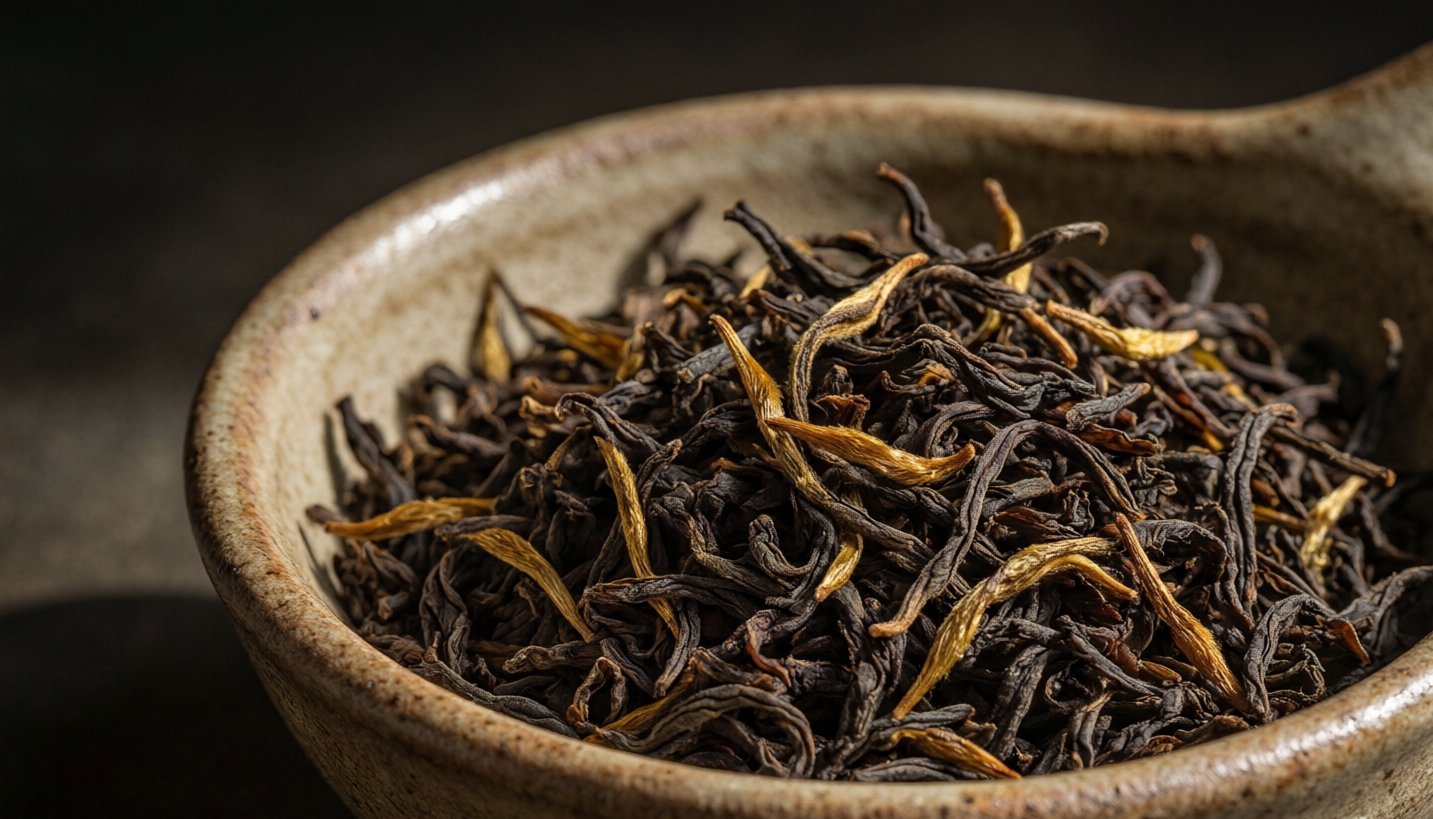
Yingde black tea has become one of China's most requested specialty black teas, but rising demand has created a predictable problem: re-labeled commodity lots, stale stock, and leaves from outside the Yingde area sold as the real thing. This buyer's test gives you a repeatable way to separate a genuine Yingde lot from a clever substitute before you commit to a container.
What Genuine Yingde Black Tea Should Look and Taste Like
Authentic Yingde black tea comes from Yingde City in northern Guangdong Province. Premium lots are built around the Yinghong 9 cultivar and related local cultivars, processed as large-leaf gongfu black tea. Under China's national standard for gongfu black tea, GB/T 13738.2—2017, the category emphasizes twisted leaf shape, uniform color, and a bright red liquor [1].
A well-made lot should show these signals:
- Dry leaf: long, tightly twisted leaves with a glossy black-brown surface and a meaningful share of golden tips.
- Aroma: warm cocoa, malt, honey, baked sweet potato, sometimes a light lychee note. A sour, burnt, or sharply artificial smell is a warning sign.
- Liquor: bright orange-red to deep red and clear, never muddy or flat brown.
- Wet leaf: even brown-red or coppery leaves that remain elastic after steeping.
Common Counterfeit Patterns in the Market
Most fake or mis-sold Yingde is not dangerous — it is simply not Yingde. The more buyers know the patterns, the harder it is for weak lots to move under a false label.
| Counterfeit pattern | What you might see | Result |
|---|---|---|
| Regional substitution | Yunnan or Guangxi black tea sold as Yingde | Different aroma, thinner cocoa-malt body |
| Re-labeled commodity red tea | Cheap domestic black tea in Yingde packaging | Flat cup, few golden tips |
| Re-dried old stock | Dull leaf, faded aroma, overly dry texture | Tastes hollow and tired |
| Flavored or colored tea | Perfume-like aroma, artificial sweetness | Fails a clean, multi-steep test |
| False origin documents | Certificate without traceable batch or bureau details | No legal basis for the origin claim |
| "Yingde-style" blends | Blended leaf sold without declaring content | Price and identity don't match |
A Buyer's Bench Test: Leaf, Liquor, and Cup
You can perform a useful first-screen test with a sample as small as 100 grams. Brew in the same way a cupping panel would: 3 grams of leaf, 150 ml of near-boiling water, and a 5-minute first steep.
| Check | Genuine signal | Fake or off signal |
|---|---|---|
| Dry leaf shape | Long, twisted, intact | Broken, uniform pellets, or dust-heavy |
| Golden tips | Present and naturally distributed | Painted or sprayed-on "gold" |
| Dry aroma | Cocoa, malt, honey | Sharp perfume, sourness, cardboard |
| First steep color | Bright orange-red to deep red | Brown, murky, or oddly uniform black |
| Second steep | Still aromatic with body | Collapses into watery, bitter liquid |
| Wet leaf | Copper-brown, elastic | Black, brittle, or artificially uniform |
| Finish | Sweet, lasting aftertaste | Astringent, sour, or chemical |
If a lot passes the bench test, move to documentation.
Need a verified lot before you buy? Send your target grade, pack size, and destination to our sourcing desk at 427728483@qq.com with "Yingde black tea sample request" in the subject line. Include your food-safety requirements so documentation can be pre-checked before sampling.
Document and Lab Checks That Separate Real Lots from Fake
Paperwork alone never proves authenticity, but it should be consistent with the tea in front of you. Strong suppliers can connect every claim to a batch number.
| Document | What it should show | Red flag |
|---|---|---|
| Origin certificate | Yingde production area and issuing bureau | No bureau contact or QR verification path |
| Lab report | Pesticide residue, heavy metals, moisture | Report older than the batch or missing batch number |
| Invoice | Grade, harvest year, production date | Vague description such as "black tea" only |
| Batch/lot record | Traceable lot number on bag and documents | Lot numbers that change between sample and shipment |
| Supplier registration | Licensed production or export scope | Company name that doesn't match the cert |
Pesticide residue testing should be assessed against China's maximum residue limits in GB 2763—2021 or the stricter destination-market limits if the tea will be exported [2]. If a buyer claims "zero residue" without a test method and limit of detection, treat the claim as marketing.
Supplier Qualifying Checklist
Ask every potential supplier these questions and compare answers across at least three options:
- Where exactly was the leaf harvested — village, garden, or cooperative?
- Which cultivar and harvest season does the lot use?
- Can you match the batch number to the origin certificate and lab report?
- What percentage of golden tips does this grade contain?
- Do you provide a pre-shipment sample sealed from the export lot?
- Which standard and method did the testing laboratory use?
- What is the moisture content of the sealed pack?
- How does your price compare with other Yingde lots of the same grade?
- Do you allow third-party inspection before loading?
- What happens if the shipped lot fails to match the approved sample?
The best answer pattern is specific, document-backed, and consistent between phone, email, and sample.
FAQ
How can I tell real Yingde black tea by taste alone?
Look for a clean cocoa-malt sweetness with honey or baked sweet potato notes and a lasting sweet finish. If the cup is sharply astringent, sour, or hollow after the second steep, it is more likely a substituted or low-grade lot.
Is imitation Yingde black tea safe to drink?
Most imitation lots are not toxic — they are ordinary black tea sold under a false name. The risk is commercial and legal: you pay for a protected identity and receive a cheaper regional product. Contamination risk depends on the actual source leaf, which is why lab documents should be checked for every shipment.
What documents prove authenticity best?
An origin certificate tied to a verifiable bureau, a batch-level pesticide and heavy-metal lab report, and an invoice that names the grade, harvest year, and lot number. Documents are strongest when the lot number appears on both the packaging and the certificate.
How much should real Yingde black tea cost?
There is no single price because grade, harvest, tip ratio, and volume all move the number. In general, authentic small-batch Yingde with good golden tips costs more than commodity Chinese black tea. If the number is very close to generic black tea, check the documents more carefully.
Should I buy first harvest only?
No. First spring harvest often has the most aromatic lift, but well-made autumn lots can offer stronger body and better value. Judge the cup first, then match harvest to the profile your customers actually prefer.
References
[1] Standardization Administration of China, "Black tea — Part 2: Gongfu black tea," GB/T 13738.2—2017, Beijing, China, 2017.
[2] National Health Commission of the People's Republic of China, "National food safety standard — Maximum residue limits for pesticides in food," GB 2763—2021, Beijing, China, 2021.
No author description available.

白玉京