How to Brew Meizhan Tea: Temperature, Ratio and Timing
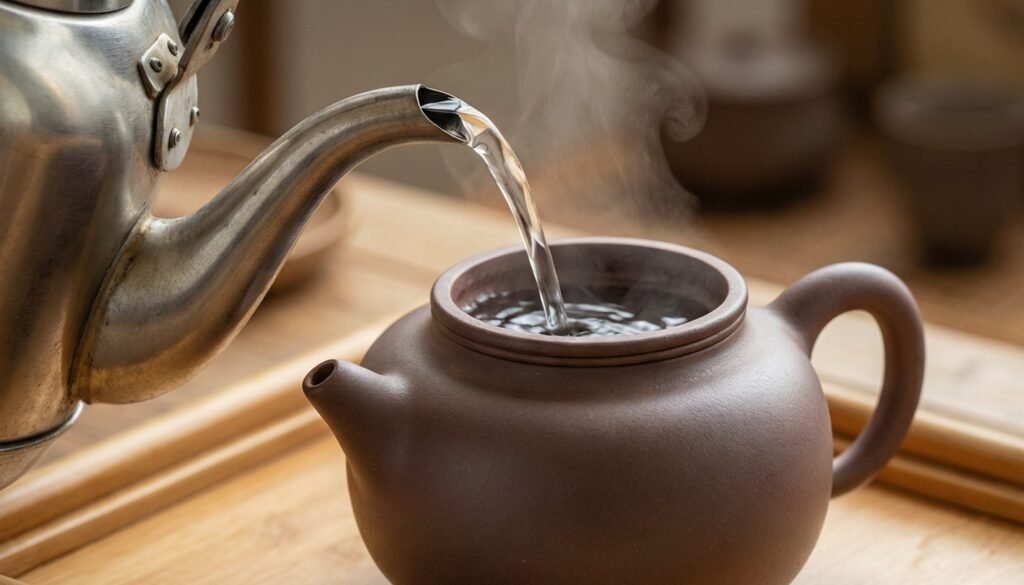
Meizhan (梅占) is a Wuyi rock tea cultivar that buyers recognise by its tight, glossy-dark leaves and a roasted aroma that moves between dark cherry, plum skin, charred honey, and wet stone. Brewed well, the liquor is red-brown, thick, and unusually long on the finish. Brewed carelessly—water too cool, leaf too light, or infusions held too long—the same tea becomes thin, sour, or flat.
The brewing window matters more for Meizhan than for many green or floral oolongs. The leaves are tightly rolled, the roast is often medium or medium-heavy, and the tea is built to be extracted in short, repeated infusions rather than a single long steep. The starting points below are used by professional tea buyers when comparing lots; adjust them to the roast level and leaf size of the batch in front of you.
What Meizhan Tea Is—and Why Brewing It Wrong Hides the Good Stuff
Meizhan is defined by the Wuyi rock-essence tea geographical indication [2], a standard that covers much of the region's rock-grown oolong production. In practice, Meizhan is produced both as a yancha-style roast and as a slightly lighter Fujian oolong; some lots are also made into black tea. The leaves tend to be slender, dark, and tightly twisted.
The characteristic notes to look for in a well-brewed cup include stewed dark fruit, roast sugar, plum skin, and a mineral, almost saline finish. If the cup is dominated by ash or char, the roast is heavy or the water was too hot for that particular lot. If the cup is empty and sweetly weak, the ratio was too light. The rest of this guide gives you a repeatable baseline to diagnose those problems.
Sourcing Meizhan rather than just brewing it? If you're buying Meizhan for a cafe menu, teahouse, or private-label line, ask the producer for the roast profile and a cupping sample brewed against the same baseline below. Email Chinese Tea Suppliers at 427728483@qq.com and tell us your target format and volume—we'll connect you with Wuyi producers before you commit.
Water Temperature: Stay Near Boiling, but Not Blindly
For most medium-roast Meizhan, a water temperature of 95–100°C (203–212°F) extracts the dark-fruit and mineral layers without pushing the roast into ash. This is consistent with standardised tea liquor preparation, which uses water at or near the boil for sensory testing [1].
For a light-roast Meizhan, start lower at 90–95°C (194–203°F) and move up if the second and third infusions feel weak. For a heavy-roast lot, stay at 100°C and shorten the steep time instead of lowering the temperature. Light-roast Meizhan can taste hollow at low temperature, but too much heat on a delicate roast can flatten the fruit notes.
Preheat the gaiwan or teapot before adding the leaf. A cold vessel drops the water temperature in the first 10 seconds, which is exactly when Meizhan releases its first burst of aroma.
Leaf-to-Water Ratio: Pick a System and Stick to It
Professional tea buyers tend to use a high leaf-to-water ratio for oolong evaluation because it exposes both strength and faults quickly [3]. For gongfu brewing, a working baseline is 1 g of leaf per 15 ml of water—about 8 g for a 120 ml gaiwan. This gives enough density for six or more infusions.
For western-style brewing, use about 3 g of leaf per 250 ml mug. The tea will open more slowly, but the cup will be less intense. Don't brew western-style with gongfu leaf weights—the result will be too strong and the later steeps will not behave the same way.
| Brewing style | Leaf weight | Water volume | Rough ratio | Typical infusions |
|---|---|---|---|---|
| Gongfu | 8 g | 120 ml | 1:15 | 6–8 |
| Western mug | 3 g | 250 ml | 1:80 | 2–3 |
| Teapot | 5 g | 300 ml | 1:60 | 2–4 |
Steep Timing by Infusion
Meizhan rewards short, controlled infusions. The first infusion should be brief; later infusions need more time because the leaf has already given up its surface compounds. The table below is a starting point. If your first steep is too light, add 2–3 seconds; if it is sour or dry, shorten it.
| Infusion | Gongfu time (120 ml) | Western time (250 ml) |
|---|---|---|
| Quick rinse | 3–5 s (discard) | — |
| 1 | 8–12 s | 2 min |
| 2 | 12–15 s | 2 min 30 s |
| 3 | 15–20 s | 3 min |
| 4 and later | add 6–10 s per steep | 3 min 30 s – 4 min |
Decant the liquor completely between infusions. Meizhan left standing in the water will continue extracting and can develop a raw, dry edge by the third infusion.
Five Common Meizhan Brewing Mistakes
- Water too cool. Under 90°C, the roasted sugars and dark fruit stay locked in the leaf, leaving a weak, wet-stone cup.
- Too little leaf. A single 2 g pinch in a 250 ml mug is not enough to carry the tea's structure.
- Skipping the quick rinse. A 3–5 second rinse wakes the tight leaf and removes surface roast dust.
- Holding the first infusion too long. Long first steeps pull too much roast out early, leaving the next infusions empty.
- Using the same time for every roast. Heavy-roast Meizhan needs shorter, more frequent infusions; light-roast needs slightly more time but lower heat.
Adjusting for Roast Level and Leaf Age
Roast level changes extraction speed. Heavy-roast Meizhan releases quickly, so shorten the first two infusions and monitor the cup for char. Light-roast Meizhan can handle a little longer first steep and a slightly lower temperature.
Aged Meizhan—stored for a year or more—is often softer and less aggressive. Start with water just off the boil, but shorten the first steep by 2–3 seconds because aged leaf opens quickly. If the tea is tightly rolled and still glossy, keep the temperature high. If the leaf is more brittle and the roast has faded, reduce temperature by 3–5°C.
Start with a Repeatable Cupping Baseline
Before you commit to a larger order, brew any Meizhan sample with a fixed protocol: 8 g in a 120 ml gaiwan, water at 100°C, rinse, then infusions of 10/12/15/18/22 seconds. This eliminates brewer variation and makes it easier to compare roast quality, leaf thickness, and aftertaste between lots. If the sample is intended for western-style packaging, run a second cupping with 3 g in 250 ml at 2 minutes.
Need a reliable Meizhan supplier? Send Chinese Tea Suppliers your target price, quantity, and brewing format—gongfu, teapot, or bulk tea-bag cut. We'll match you with verified Wuyi producers and arrange cupping samples before commitment. Email your requirements to 427728483@qq.com.
Frequently Asked Questions
What is the best water temperature for Meizhan tea?
For a standard medium-roast Meizhan, 95–100°C (203–212°F) is a reliable starting point. Light-roast lots can start at 90–95°C, and heavy-roast lots do well at 100°C with shorter steeps.
How much Meizhan tea should I use per cup?
For gongfu, use about 1 g per 15 ml of water—roughly 8 g in a 120 ml gaiwan. For a 250 ml mug, use about 3 g of leaf.
How long should the first infusion of Meizhan tea steep?
In gongfu, keep the first infusion to about 8–12 seconds after the rinse. For a 250 ml western mug, start at about 2 minutes.
Can Meizhan tea be brewed western-style?
Yes. Use 3 g of leaf per 250 ml of water and keep the infusion to about 2 minutes. Western-style brewing gives fewer infusions and a softer cup than gongfu.
How many times can Meizhan tea leaves be re-steeped?
A high-quality medium-roast Meizhan will usually give six to eight gongfu infusions. Western-style brewing typically gives two to three infusions.
References
[1] ISO 3103:1980. Tea — Preparation of liquor for use in sensory tests. International Organization for Standardization. [Standard]
[2] GB/T 18745-2006. Product of geographical indication — Wuyi rock-essence tea. Standardization Administration of China. [Standard]
[3] GB/T 23776-2018. Methodology for sensory evaluation of tea. Standardization Administration of China. [Standard]
No author description available.

白玉京