High Mountain Green Tea: Why It Costs So Much
Mountain-grown Chinese green tea often carries the highest price tags in a spring tea catalog, yet the reason is rarely one single factor. The premium sits at the intersection of agronomy, labor, and a very short seasonal window. This guide explains where the cost comes from and, more importantly, how to check whether the lot in front of you actually deserves it.
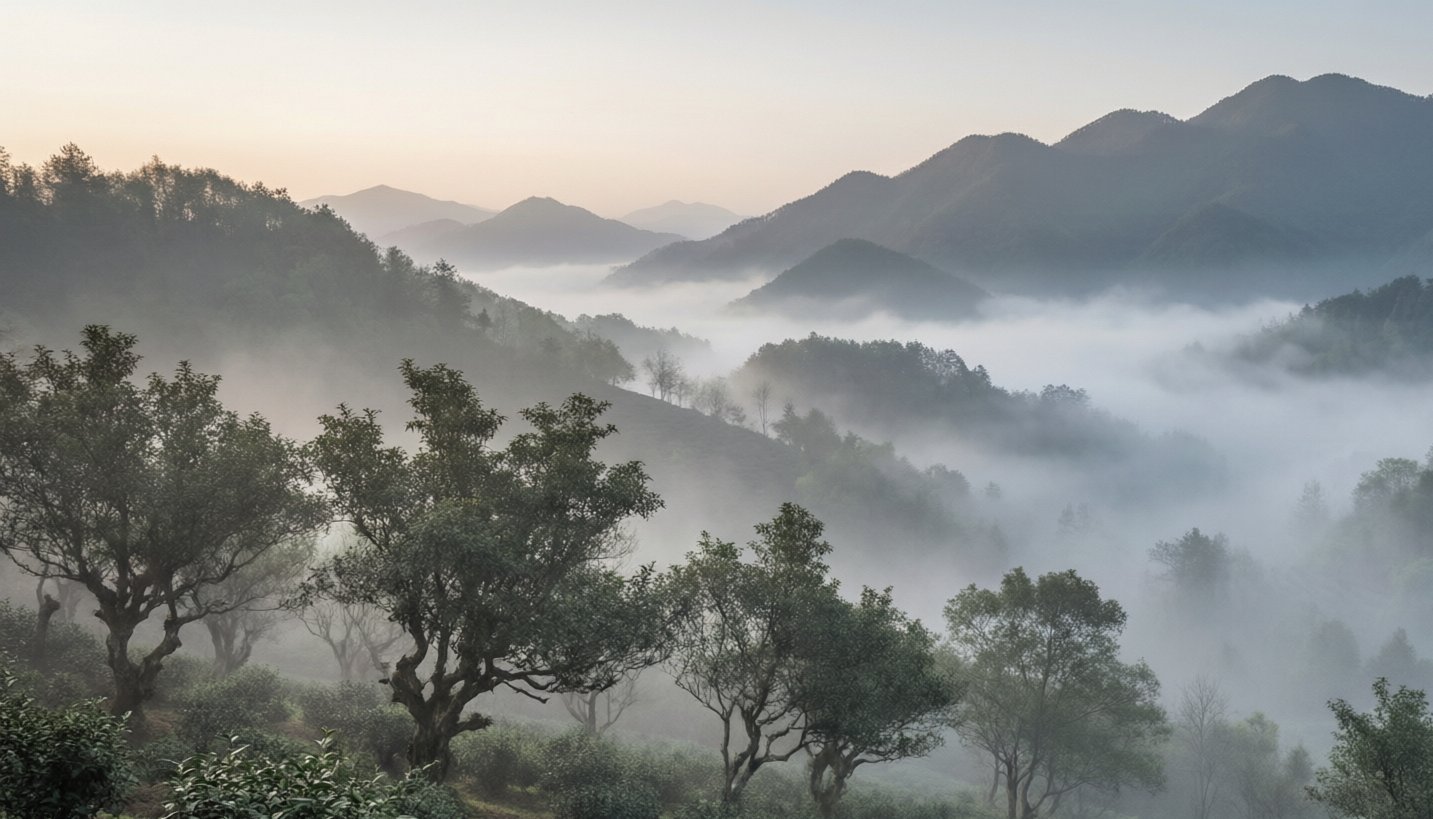
What “High Mountain” Actually Means
No national regulation in China fixes a single altitude at which green tea becomes “high mountain.” In practice, the term is used regionally: many gardens marketed this way sit above 700–800 m, and some prized lots grow above 1,000 m. Green tea standards such as GB/T 14456.1 define product and sensory requirements rather than a mountain cutoff [5]. ISO 11287 likewise defines green tea by processing method, not elevation [6].
That matters for buyers. A supplier using “high mountain” without giving the garden’s altitude, village, or mountain range is selling a vague claim. The origin should be checkable. Well-known high-elevation and mountain-green tea examples include Duyun Maojian from Guizhou, Enshi Yulu from Hubei, Lushan Yunwu from Jiangxi, Mengding Ganlu from Sichuan, and Huangshan Maofeng from Anhui. Price differences among these origins reflect both elevation and the specific microclimate of each site.
Slow Growth, Small Yields, and the Flavor Chemistry
Higher elevation generally means cooler average temperatures, stronger ultraviolet exposure, and frequent cloud cover. In those conditions, tea shoots grow more slowly. A slower growth cycle reduces total yield per unit of land but tends to preserve certain amino acids, particularly L-theanine, that contribute sweetness and a softer mouthfeel [2]. The same slower metabolism can keep bitterness lower than in fast-grown, sun-exposed lowland leaf.
This is an agronomic trade-off, not a guarantee of quality. A high-elevation garden with poor picking discipline will not automatically beat a well-managed lowland garden. But the cost structure is real: if each flush is smaller and takes longer to reach picking standard, the same amount of labor and land produces fewer kilograms of finished tea.
Narrow Harvest Windows and Hand-Picking Economics
Green tea’s most famous price driver is timing. The very early spring flush—before Qingming, usually early April—is scarce because winter dormancy ends slowly and cold snaps can delay new buds. Chinese buyers commonly call this “Mingqian” or pre-Qingming tea; it is the same leaves that generate the highest first-flush prices at origin.
Good lots are still picked by hand [3]. On steep terraces, pickers move more slowly than on flat fields, and standards such as one bud with one leaf, or one bud with two leaves, lower daily output. Add labor-intensive sorting after picking, and the equation becomes clear: high mountain green tea is expensive in part because it requires more hours per finished kilogram just to remove the stem, broken, and non-standard material.
Microclimate, Sorting, and the Real Cost of Clean Leaf
Mist and fog play a practical role: they diffuse light and keep leaf surfaces moist, conditions many growers associate with tender leaf and lower bitterness. Diurnal temperature swings—cool nights after warm days—can also influence aroma development. Where these microclimates produce thick, small, slow-grown buds, authentic lots may look less uniform than machine-styled lowland tea.
The price a buyer pays also reflects yield loss during cleaning and finishing. Machine-sorted and hand-sorted tea loses a share of its raw leaf before packing. Then the finished product is usually sealed in nitrogen-flushed or oxygen-barrier packaging to protect freshness, which adds cost per unit. China remains the world’s largest tea producer, and strong domestic demand for famous mountain origins supports higher prices [1]. Each of these steps is where a cheap lot can be “upgraded” by marketing language alone.
Quick sourcing note: If you are benchmarking high mountain lots, start with the harvest date, garden altitude band, and a cuppable sample. You can contact us at 427728483@qq.com for current lot profiles and wholesale specifications.
How to Verify a High Mountain Premium
Use the table below to separate a real mountain premium from a label.
| Signal | What to Ask | What Consistent High-Mountain Quality Looks Like |
|---|---|---|
| Garden traceability | Exact village, mountain, and altitude band | A specific origin, not “China high mountain” |
| Harvest date | Picking date and flush | Early spring date; later flushes should be cheaper |
| Leaf condition | Clear photograph of dry leaf | Smallish, neat, slightly thicker buds; not necessarily perfect uniformity |
| Aroma | Dry and wet leaf notes | Fresh, floral, nutty, or vegetal depending on style; no stale or sour note |
| Liquor | Cupping sample | Clear, sweet, soft astringency, and lasting return sweetness |
| Re-steeping | How many solid infusions it gives | High mountain lots often hold flavor across more infusions |
| Price logic | Why this lot is priced above another | Explanation tied to harvest, origin, labor, and grade—not only story |
Sourcing High Mountain Green Tea
For importers, tea brands, and retailers, the most important habit is to separate origin facts from origin stories. Ask the supplier to state the garden altitude, picking date, flush, cultivar, and grade in writing. Request a batch sample before volume purchase, then cup it against a lowland control lot to see whether the premium translates into texture, sweetness, and longevity.
When you have a target grade and destination market, email 427728483@qq.com to discuss current availability and wholesale terms.
Frequently Asked Questions
Is high mountain green tea always better than lowland green tea?
No. Elevation is only one variable. Cultivar, harvest timing, picking standard, processing, and freshness can easily outweigh altitude. A good lowland lot can beat a careless mountain lot.
What is the single biggest reason high mountain green tea is expensive?
There isn’t one. Scarcity, slower growth, hand-picking, and early-spring demand work together. Most of the price is structural, not arbitrary.
How can I tell if an altitude claim is believable?
Ask for the exact village or mountain, altitude band, and batch traceability. Then check the harvest date, leaf appearance, and cupping performance. Vague wording is a red flag.
Does high mountain green tea have more health benefits than regular green tea?
Claims should stay modest. Processing and leaf age affect composition, but “high mountain” alone is not a certified health claim. The stronger argument is usually taste and rarity.
Is pre-Qingming high mountain green tea worth the premium for a business?
It depends on your customer. If your market pays for freshness, story, and delicate first-flush flavor, yes. If you compete on value, a later flush or lower-altitude lot may be the better margin call.
References
[1] Food and Agriculture Organization of the United Nations. FAOSTAT: Crops and livestock products — tea. FAO, Rome.
[2] Chen, L., Zhou, Z.-X., & Yang, Y.-J. “Genetic improvement and breeding of tea plant (Camellia sinensis) in China.” Euphytica, vol. 154, 2007, pp. 167–179.
[3] National Bureau of Statistics of China. China Statistical Yearbook 2025. China Statistics Press, Beijing.
[5] Standardization Administration of the People’s Republic of China. GB/T 14456.1-2017 Green tea — Part 1: Basic requirements.
[6] International Organization for Standardization. ISO 11287:2011 Green tea — Definition and basic requirements.
No author description available.

白玉京