Guizhou White Tea Health Effects: What the Evidence Shows
When buyers ask whether Guizhou white tea has proven health effects, the honest answer starts with the tea category before the origin. White tea is the least oxidized form of Camellia sinensis, and most of its studied effects come from polyphenols, caffeine, and L-theanine [1]. Guizhou adds terroir, cultivar, and processing variables, but there are relatively few clinical trials that test Guizhou white tea by name. The responsible way to read the evidence is therefore to combine what is known about white tea in general with what can be observed in a well-made Guizhou lot.
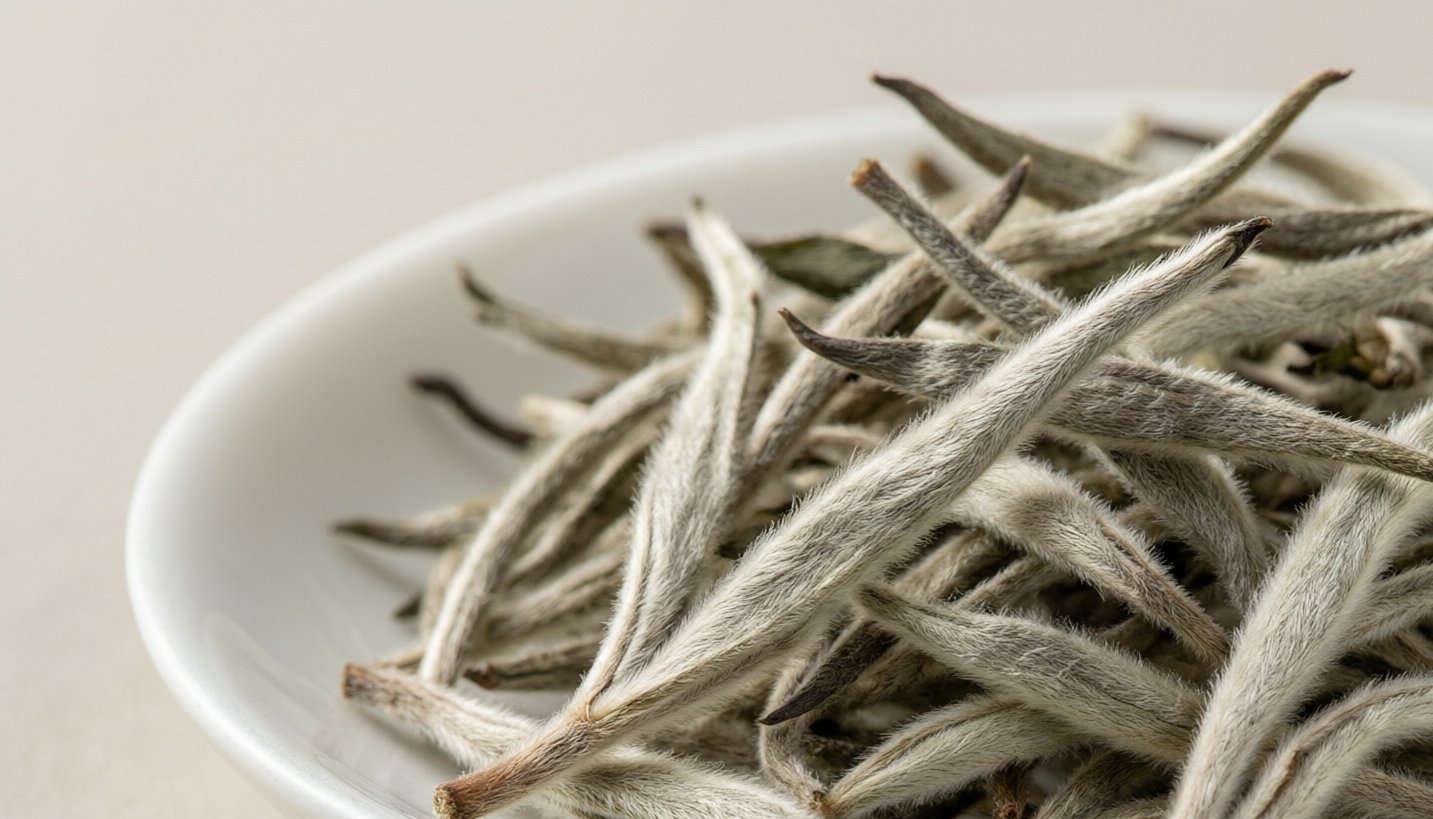
What Is Guizhou White Tea?
White tea is defined by minimal processing. Fresh leaves are withered and dried, with no pan-firing or deliberate rolling that fully fixes leaf enzymes. This gentle treatment retains a phenolic profile that differs from green or black tea [1]. Guizhou white tea is often made from cultivars such as Fuding Dabaicha, Qianmei, or local high-altitude tea varieties, and much of the province's tea land sits in mountainous, fog-prone areas above 1,000 meters. Those conditions are generally associated with slower leaf growth and higher retention of amino acids, although the final chemistry still depends on harvest standard, weather, and drying control.
The practical result is that Guizhou white tea can present a softer, slightly sweet cup with a clean aromatic finish. For health-focused buyers, what matters is not only the taste but how the processing preserves the compounds listed below.
Bioactive Compounds in Guizhou White Tea
The health discussion around white tea centers on a small number of compound groups.
| Compound group | Why it matters | Evidence note |
|---|---|---|
| Catechins such as EGCG, ECG, and EGC | Antioxidant and metabolic effects in cell and animal models | [1][2] |
| L-theanine | Supports calm alertness and may moderate caffeine response | [1][2] |
| Flavonols and other polyphenols | Contribute to total antioxidant capacity | [1][2] |
| Caffeine | Mild central nervous system stimulation; amount varies widely | [2][3] |
These compounds are not unique to Guizhou white tea, but the white tea processing route tends to preserve more of the original catechin content than full oxidation would [1]. This is one reason white tea is often described as a “high-retention, low-oxidation” tea style.
Evidence-Backed Health Effects
Antioxidant capacity
White tea extracts show free-radical scavenging activity in laboratory studies, and these effects are usually attributed to catechins and related polyphenols [1][2]. Human data on white tea specifically is thinner than for green tea, so the findings should be read as supportive rather than definitive. The National Center for Complementary and Integrative Health notes that tea polyphenols have antioxidant properties in the laboratory, but the clinical significance for human health is still not fully established [3].
Weight management support
Some meta-analyses of green tea catechins and caffeine report a small, statistically significant effect on body weight and weight maintenance under controlled energy intake [4]. White tea contains similar catechins, but fewer trials use white tea directly. In vitro work has also shown that white tea polyphenols can inhibit digestive enzymes such as alpha-amylase and pancreatic lipase [5]. That does not mean white tea functions as a weight-loss drug; it means the compounds interact with pathways that may modestly support metabolic management in the presence of an overall dietary pattern.
Cardiometabolic health
Population studies have linked regular tea consumption with lower risk of cardiovascular outcomes and total mortality, though most long-term evidence comes from green and black tea [6]. White tea has not been studied at the same scale, but its polyphenol profile overlaps enough that it is often grouped with other minimally processed teas in this discussion. Laboratory data also suggest white tea polyphenols may influence lipid and glucose metabolism [5][6]. Claims should stay at the level of “may support” rather than guarantee, because the endpoint trials are not yet there.
Oral health
Tea polyphenols have shown antimicrobial and anti-adhesion effects against oral bacteria in laboratory and short clinical studies, and tea is a dietary source of fluoride [2][7]. For Guizhou white tea, this primarily means that unsweetened white tea is a more tooth-friendly daily drink than sugar-sweetened tea beverages. It is not a substitute for brushing, flossing, or professional dental care.
Calm alertness
L-theanine appears to promote a state of relaxed attention, and its combination with caffeine is one of the most studied functional relationships in tea [2]. White tea provides both compounds, although the exact ratio depends on leaf material and brewing. Many drinkers describe white tea as gentler than strong green tea, but individual response to caffeine still varies.
What the Research Does Not Prove Yet
No large, controlled clinical trial has isolated Guizhou white tea as the intervention and tracked long-term disease outcomes. The gaps are important: extraction methods, cultivar, harvest date, storage time, and brewing all change the final polyphenol and caffeine content. A health effect observed in a standardized extract cannot be automatically assigned to any commercial lot of loose-leaf tea.
This does not make the existing research useless; it means the strongest language a supplier or buyer can honestly use is “white tea contains compounds with demonstrated bioactivity in laboratory and short-term human studies, and Guizhou white tea shares those characteristics when it is produced from fresh, clean leaf and brewed properly.”
Safe Daily Intake and Who Should Be Careful
For healthy adults, the European Food Safety Authority considers habitual caffeine intakes up to 400 mg per day to be of no safety concern, with single doses up to about 200 mg also considered acceptable for most adults [8]. White tea is generally lower in bitter intensity than many green teas, but its caffeine content is not automatically low. Bud-heavy silver-needle material can carry meaningful caffeine, especially with long steeping.
Sensitive groups should moderate intake: pregnant and breastfeeding women, people with iron-deficiency tendencies, and those who experience sleep disruption or anxiety from caffeine. Tea polyphenols can reduce nonheme iron absorption when tea is consumed with meals [2][3][8]. A practical rule is to avoid using Guizhou white tea as a meal-time replacement for iron-rich foods and to monitor caffeine tolerance individually.
How to Brew Guizhou White Tea for Health Compounds
Gentle brewing preserves flavor and avoids drawing excessive bitterness out of tender leaf. For most Guizhou white tea, start with water around 80–85 °C and steep for roughly two to three minutes. Bud-heavy material can take slightly cooler water, while larger-leaf grades may need another half minute. Short repeated infusions work well, but the main health compounds are not tied to a single exact recipe. The point is to use fresh, good-quality water and avoid boiling temperatures that make the cup harsh.
Quality Cues for Health-Focused Buying
Freshness and clean production matter more than marketing language. Look for intact buds or leaf sets with visible silver down where appropriate, a clean dry aroma, and no musty or sour note. Ask for the harvest year, leaf standard, moisture content, and pesticide residue documentation. For white tea bought for health-led retail positioning, sensory clarity is a useful proxy: dull, flat, or stale aromatics often track with poor storage or old stock. It is also reasonable to request a lot-specific specification sheet before committing to volume.
Sourcing Guizhou White Tea: Next Steps
If you are buying Guizhou white tea for retail, private label, foodservice, or wellness-led product lines, send the following to start a focused inquiry:
- Target grade and leaf standard: single bud, one bud one leaf, or larger leaf grade
- Required packaging format and quantity range
- Destination market and any certification or residue-test needs
- Whether you want fresh-harvest lots or aged white tea
- Preferred sample and lab-documentation workflow
Contact our sourcing team at 427728483@qq.com with your specification. A practical first step is to request a physical sample set and current harvest details before negotiating pricing or packaging.
Frequently Asked Questions
Is Guizhou white tea the same as Fuding white tea?
No. They share white tea processing, but Fuding white tea is strongly associated with Fujian province and Fuding-area cultivars, while Guizhou white tea comes from Guizhou's high-altitude tea gardens and may use different cultivars or local leaf standards. The flavor can be softer, lighter, or more mineral depending on the lot, but both belong to the same low-oxidation tea category.
How much Guizhou white tea can I drink per day?
Most healthy adults can drink several cups a day while staying within general caffeine guidance, but there is no universal cup count because caffeine varies by material and brewing. If you feel jittery, have trouble sleeping, or take medication, reduce the amount or shift to earlier in the day.
Does Guizhou white tea have less caffeine than green tea?
Not automatically. Caffeine depends on cultivar, leaf maturity, brewing temperature, steeping time, and leaf-to-water ratio. A bud-heavy white tea steeped at high temperature can deliver as much or more caffeine than a light green tea infusion.
Does white tea really “detox” the body?
“Detox” is not a regulated health claim for tea. White tea polyphenols may support the body's own antioxidant and metabolic systems, but tea does not strip toxins from the body in the way popular marketing sometimes suggests. The best framing is that unsweetened white tea can replace higher-sugar drinks and contribute to overall hydration and polyphenol intake.
How should I store Guizhou white tea for long-term freshness?
Keep it sealed, dry, cool, and away from strong odors. Avoid direct sunlight and high humidity. For short-term retail or home use, an airtight, opaque container is enough. For wholesale storage, control moisture and temperature, and rotate stock so older lots do not become stale.
References
- Dias TR, Tomás G, Teixeira NF, Alves MG, Oliveira PF, Silva BM. White tea (Camellia sinensis (L.): chemical composition and health-promoting effects. Food Funct. 2013;4(6):865-872.
- Hayat K, Iqbal H, Malik U, Bilal U, Mushtaq S. Tea and its consumption: benefits and risks. Crit Rev Food Sci Nutr. 2015;55(7):939-954.
- National Center for Complementary and Integrative Health. Green Tea. NCCIH; reviewed 2020. https://www.nccih.nih.gov/health/green-tea
- Hursel R, Viechtbauer W, Westerterp-Plantenga MS. The effects of green tea on weight loss and weight maintenance: a meta-analysis. Int J Obes (Lond). 2009;33(9):956-961.
- Tenore GC, Stiuso P, Campiglia P, Novellino E. In vitro hypoglycaemic and hypolipidemic potential of white tea polyphenols. Food Chem. 2013;141(3):2379-2384.
- Zhang C, Qin YY, Wei X, Yu FF, Zhou YH, He J. Tea consumption and risk of cardiovascular outcomes and total mortality: a systematic review and meta-analysis. Eur J Epidemiol. 2015;30(2):103-113.
- Goenka P, Sarawgi A, Karun V, Nigam AG, Dutta S, Marwah N. Camellia sinensis (Tea): implications and role in preventing dental caries. Pharmacogn Rev. 2013;7(14):152-156.
- EFSA Panel on Dietetic Products, Nutrition and Allergies. Scientific Opinion on the safety of caffeine. EFSA J. 2015;13(5):4102.
No author description available.

白玉京