Dianhong (Yunnan Black) Tea: Evidence-Based Health Effects
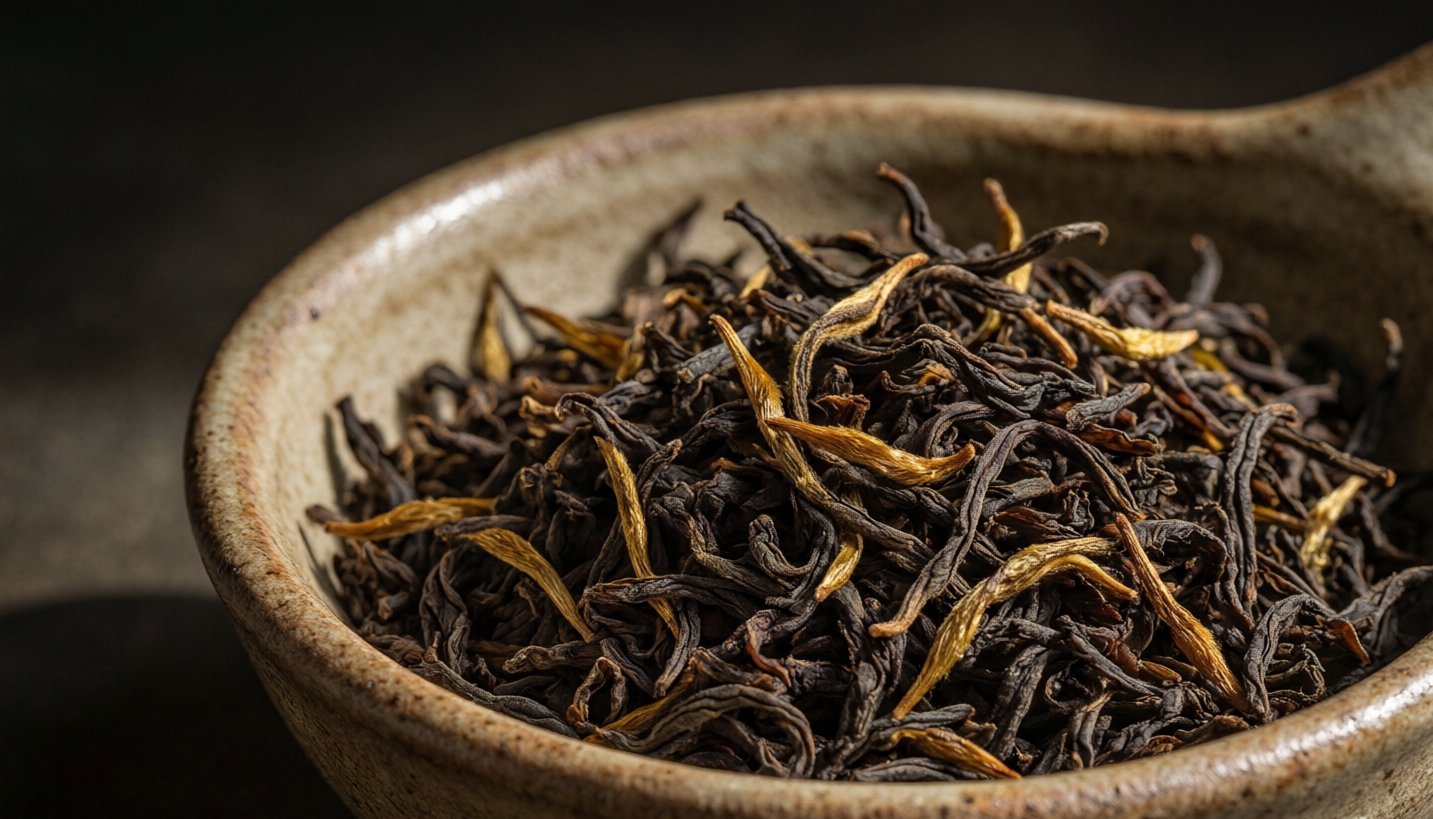
Dianhong, often called Yunnan black tea in English, is not simply a dark-colored green tea. It is a fully oxidized black tea made primarily from the large-leaf Camellia sinensis var. assamica cultivar grown in Yunnan. That processing difference changes its polyphenol profile, its caffeine behavior, and the way health claims should be interpreted.
Most of what drinkers read about tea and health comes from green tea research. Dianhong deserves its own evidence-based look because its dominant compounds are theaflavins, thearubigins, and other oxidation products rather than the fresh catechins such as EGCG that dominate green tea studies [1].
What Dianhong Actually Is — and Why the Chemistry Matters
Dianhong is produced in Yunnan's high-elevation tea belts, particularly around Fengqing and Lincang. The leaves are withered, rolled, fully oxidized, and dried. Oxidation converts many of the leaf's original catechins into theaflavins and thearubigins, which give the brew its reddish-amber color and malty, cocoa-like character [1].
Golden-tip Dianhong indicates a high proportion of buds and fine picking. It matters for aroma, texture, and grade, but there is little clinical evidence that golden-tip Dianhong has a different health profile than standard Dianhong made from larger leaves.
This distinction matters. When a green tea trial reports a benefit from a specific catechin dose, that result cannot be automatically transferred to Dianhong. Black tea has a different chemical structure, and its clinical effects need to be evaluated as black tea [1][4].
Health Effects with the Strongest Evidence
Heart and circulation. The best human evidence for black tea involves cardiovascular health. A systematic review and meta-analysis found that higher tea consumption was associated with lower cardiovascular outcomes and total mortality, with black tea studies contributing to the overall protective pattern [2]. A separate meta-analysis reported that both green and black tea consumption were associated with reduced stroke risk [3].
The likely mechanism is not a simple “antioxidant boost.” Tea flavonoids appear to influence nitric oxide availability, blood vessel function, and modest blood pressure regulation [4]. These are realistic, whole-beverage effects rather than isolated supplement effects.
Metabolic health. Observational studies suggest an association between regular black tea intake and better metabolic markers, but the effect size is small and easily influenced by overall diet and lifestyle. Dianhong can fit into a healthy routine, but it should not be treated as a blood sugar or insulin treatment.
Mental alertness. Dianhong contains moderate caffeine, generally less than a comparable serving of brewed coffee. For most adults, moderate intake is compatible with standard caffeine safety guidance [9].
If you are evaluating Dianhong for a wholesale or functional-beverage program, ask for batch-level documentation on caffeine, polyphenol content, and pesticide residues. Our sourcing team can arrange graded Dianhong samples with supporting lab records — email 427728483@qq.com with your target grade and order volume.
Claims That Need More Evidence
Weight loss and “detox.” The strongest weight-related tea trials usually use concentrated green tea catechin-caffeine extracts at doses that are difficult to replicate with brewed whole-leaf Dianhong. Even in those trials, the effect on body weight is small and inconsistent [6]. There is no robust human trial showing that drinking Dianhong alone produces meaningful weight loss.
Cancer prevention. Laboratory and animal studies show that tea polyphenols can affect cancer-related pathways, but human evidence remains inconsistent and cannot support the claim that any single tea prevents cancer in people [5]. This applies to Dianhong as much as to green tea or any other tea category.
“Dianhong-only” cures. Most published research examines black tea as a category. A specific claim about Dianhong is not automatically stronger than the broader black tea evidence unless a clinical study actually used Dianhong. In most cases, the responsible statement is: Dianhong is a fully oxidized black tea, and it shares the general evidence base of black tea.
Practical Safety and Who Should Limit It
For most adults, moderate Dianhong consumption presents little concern. The main practical limits come from caffeine, tannins, and absorption interactions.
Caffeine is the most predictable issue. European Food Safety Authority guidance supports a moderate daily caffeine intake for healthy adults, with lower limits during pregnancy [9]. If you are sensitive to caffeine, avoid late-day Dianhong or reduce steeping time.
Black tea polyphenols can inhibit the absorption of non-heme iron from plant foods when tea is consumed with a meal. If iron status is a concern, separate tea from iron-rich meals by at least an hour [8].
Anyone taking regular medication, especially medication affected by iron absorption or stimulant intake, should discuss tea consumption with a clinician. This is not a Dianhong-specific warning; it is standard caution for any caffeinated, tannin-rich beverage.
Finally, source quality matters for a tea consumed daily. Reputable importers and wholesalers should be able to provide current test reports for pesticide residues and heavy metals. A low price should not replace that documentation.
Brewing Dianhong for Everyday Drinking
Dianhong brews best at 90–95°C with 3–5 minutes of steeping. A practical starting ratio is about 1 gram of leaf per 50 milliliters of water, adjusted to taste. Golden-tip Dianhong can be slightly more delicate, so 90°C and a shorter steep often preserve its honeyed finish.
A short rinse is optional and mainly warms the leaves. Dianhong typically gives two or three satisfying infusions, though later infusions become lighter and less malty. Adding milk is traditional for stronger Dianhong, but it will change the perceived astringency and mouthfeel.
Sourcing Dianhong for Your Business
For importers, tea brands, and wellness product developers, the health conversation only matters if quality is verifiable. When evaluating Dianhong supply, request the harvest season, grade description, origin details, and current laboratory documentation for caffeine and contaminant screening.
Our team works with Chinese tea suppliers to match buyers with graded Dianhong according to target profile, leaf style, and volume. Email 427728483@qq.com to discuss samples, specifications, and wholesale terms.
Frequently Asked Questions
Is Dianhong as healthy as green tea?
Dianhong is not necessarily healthier or less healthy than green tea; it is different. Green tea retains more fresh catechins such as EGCG, while Dianhong is richer in theaflavins and thearubigins formed during oxidation [1]. Both have observational support for cardiovascular benefit, but the compound profiles and clinical evidence are not interchangeable.
How much Dianhong can I drink per day?
Most healthy adults can consume two to four cups per day within common caffeine guidance. People who are pregnant, caffeine-sensitive, or managing sleep problems should adjust intake downward and follow clinician advice [9].
Does Dianhong stain teeth more than green tea?
Black teas, including Dianhong, tend to contain more dark pigments and staining compounds than green or white tea. The stain risk is real but manageable. Rinsing with water after drinking, using a straw, and maintaining normal dental hygiene reduce the visible effect.
Is Dianhong safe during pregnancy?
Dianhong is safe for most people in small amounts, but caffeine intake should be limited during pregnancy. The relevant safety question is total daily caffeine from all sources, not only tea [9]. Pregnant women should confirm a personal caffeine limit with their healthcare provider.
Is golden-tip Dianhong more healthful than regular Dianhong?
Golden-tip Dianhong usually indicates a higher proportion of buds, which affects aroma, texture, and market grade. There is no strong evidence that it has a clinically different health effect than standard Dianhong made from older leaves.
References
[1] E. J. Gardner, C. H. S. Ruxton, and A. R. Leeds, “Black tea—helpful or harmful? A review of the evidence,” Eur. J. Clin. Nutr., vol. 61, no. 1, pp. 3–18, 2007. doi:10.1038/sj.ejcn.1602489.
[2] C. Zhang, Y.-Y. Qin, X. Wei, F.-F. Yu, Y.-H. Zhou, and J. He, “Tea consumption and risk of cardiovascular outcomes and total mortality: a systematic review and meta-analysis,” Eur. J. Epidemiol., vol. 30, no. 2, pp. 103–113, 2015. doi:10.1007/s10654-014-9960-x.
[3] L. Arab, W. Liu, and D. Elashoff, “Green and black tea consumption and risk of stroke: a meta-analysis,” Stroke, vol. 40, no. 5, pp. 1786–1792, 2009. doi:10.1161/STROKEAHA.108.538470.
[4] J. M. Hodgson and K. D. Croft, “Tea flavonoids and cardiovascular health,” Mol. Aspects Med., vol. 31, no. 6, pp. 495–502, 2010. doi:10.1016/j.mam.2010.09.004.
[5] C. S. Yang, X. Wang, G. Lu, and S. C. Picinich, “Cancer prevention by tea: animal studies, molecular mechanisms and human relevance,” Nat. Rev. Cancer, vol. 9, no. 6, pp. 429–439, 2009. doi:10.1038/nrc2641.
[6] R. Hursel and M. S. Westerterp-Plantenga, “Catechin- and caffeine-rich teas for control of body weight in humans,” Am. J. Clin. Nutr., vol. 98, no. 6, pp. 1682S–1693S, 2013. doi:10.3945/ajcn.113.058396.
[7] C. D. Wu and G. X. Wei, “Tea as a functional food for oral health,” Nutrition, vol. 18, no. 5, pp. 443–444, 2002. doi:10.1016/S0899-9007(02)00763-4.
[8] R. F. Hurrell, M. Reddy, and J. D. Cook, “Inhibition of non-haem iron absorption in man by polyphenolic-containing beverages,” Br. J. Nutr., vol. 81, no. 4, pp. 289–295, 1999. doi:10.1017/S0007114599000537.
[9] EFSA Panel on Dietetic Products, Nutrition and Allergies, “Scientific opinion on the safety of caffeine,” EFSA J., vol. 13, no. 5, p. 4102, 2015. doi:10.2903/j.efsa.2015.4102.
No author description available.

白玉京