Zhejiang green tea is a family rather than a single product: West Lake Longjing, Anji Baicha, Jingshan green tea, Kaihua Longding and Huiming tea all come from the province, and they are processed differently enough that buyers should not treat them as interchangeable. The direct answer is yes for most healthy adults who drink brewed leaf tea in normal amounts, but the category carries a lot of health marketing that the evidence does not fully support.
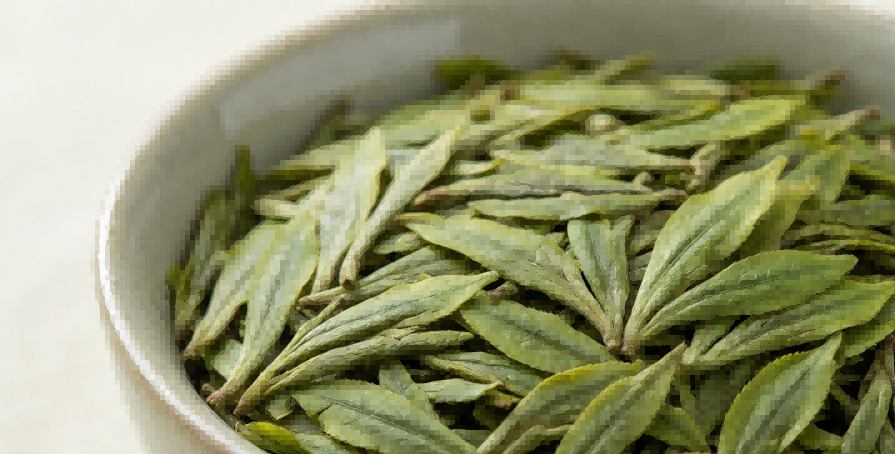
What Counts as Zhejiang Green Tea?
Longjing is the best-known example and the one with the clearest legal identity. It is a protected geographical indication product, and the Chinese national standard for Longjing tea is GB/T 18650-2008, which sets requirements for origin, grade, sensory quality and processing [1]. Anji Baicha adds confusion because “Bai Cha” usually means white tea; Anji Baicha is processed as a green tea, but made from the light-colored Bai Ye No.1 cultivar. Jingshan green tea, Kaihua Longding and Huiming tea are smaller-volume regional greens.
From a health perspective, they all start from the same leaf species—Camellia sinensis—but harvest date, cultivar, shade, rolling, firing and grade change the final chemistry.
What the Evidence Actually Shows
Green tea research concentrates on four groups of compounds: catechins, with epigallocatechin gallate (EGCG) the most studied; L-theanine; caffeine; and minerals such as fluoride [2], [3]. The following table summarizes their roles and how strong the human evidence is.
| Component | Main studied effects | Human evidence strength |
|---|---|---|
| Catechins (EGCG) | Antioxidant, anti-inflammatory, lipid metabolism support | Mixed to moderate |
| L-theanine | Calm focus; smooths caffeine response | Moderate |
| Caffeine | Alertness, attention, physical performance | Strong |
| Fluoride | Oral health support | Moderate |
| Tea polysaccharides | Blood glucose modulation | Preliminary |
The pattern is consistent: tea is a reasonable functional beverage, but it is not a purified drug. Many of the most dramatic results come from animal or cell studies using catechin concentrations that are difficult to reach through drinking tea [2].
Where the Evidence Is Strongest
Cardiovascular health is the best-supported area. In the Ohsaki cohort study from Japan, green tea consumption was associated with lower cardiovascular and all-cause mortality; the association was strongest among those drinking several cups daily [4]. That is still observational evidence—it shows correlation, not proof of cause.
Cognition and alertness are also reasonably well documented. L-theanine combined with caffeine has been shown in controlled trials to improve attention and reduce some of the jitteriness associated with caffeine alone [5]. This helps explain why green tea feels different from coffee even when both contain caffeine.
Weight management evidence is real but modest. A meta-analysis of green tea trials found a small effect on weight loss and weight maintenance compared with control groups, not a dramatic one [6]. Oral health is another area with published support: tea fluoride and catechins have been linked to lower plaque formation and antioxidant protection in the mouth [7].
Cancer prevention, by contrast, remains unresolved. Human trials and prospective studies have not produced consistent enough results to justify “anti-cancer” labels on tea products, and responsible sellers should not use that language [2].
Risks, Limits and Who Should Be Cautious
Brewed tea and concentrated green tea extract are not the same risk profile. The European Food Safety Authority has warned that high-dose green tea catechins—mainly from supplements taking in 800 mg or more of EGCG per day—have been associated with liver injury, while ordinary brewed green tea consumed as a beverage has not raised the same concern [8]. The lesson is simple: drink tea, but do not treat extracts as a harmless shortcut.
Caffeine is the other practical limit. Green tea contains caffeine, though generally less than coffee. People who are pregnant should keep total daily caffeine within medical guidance, commonly 200 mg per day [9]. Tannins in green tea can reduce absorption of non-heme iron from plant foods, so people with iron-deficiency anemia may want to drink tea between meals rather than with meals [2]. Some individuals also experience stomach irritation from strong tea on an empty stomach.
Does Grade or Harvest Make a Difference?
Yes, but mostly for taste and price rather than a clean “healthier” ranking. Early-spring, high-grade Longjing tends to be higher in free amino acids, especially theanine, which produces a softer, sweeter cup. Later-harvest leaves often have more catechins and a sharper, more astringent profile. Neither profile makes one tea a superfood, and a premium price does not automatically mean superior health effect.
Quality control probably matters more than grade. Zhejiang green tea is only as good as the lot’s pesticide residue, heavy metal and moisture data. A budget tea with clean test reports can be a safer daily drinker than an unverified “premium” lot.
If you are sourcing Longjing or Anji Baicha for a private-label or retail range, keep the labeling conservative. Request batch-level pesticide, heavy metal and moisture reports, then cup the lot against the grade you were quoted. If you need help matching a Zhejiang green tea lot to your target market and volume, email 427728483@qq.com with the grade, harvest and volume you have in mind.
Brewing for Benefit Without the Downsides
Brewing changes both enjoyment and extractability. Use water around 80°C rather than boiling water, start with short steeps of 20–40 seconds for high-grade leaf, and avoid over-brewing if the tea turns astringent. Drink the infusion fresh, not as a high-dose concentrate. This gives the catechins, theanine and caffeine time to extract while keeping the cup pleasant enough to repeat daily.
Watch your context as well. If you are sensitive to caffeine, do not drink strong green tea late in the day. If you have an iron deficiency, separate tea from iron-rich meals by an hour or more.
Bottom Line: Is Zhejiang Green Tea Actually Good for You?
For most healthy adults, yes—Zhejiang green tea is a useful daily beverage with moderate published support for cardiovascular, cognitive and oral health, a modest role in weight management, and no clinical reason to call it a cure. The benefit comes from consistent, brewed consumption as part of an otherwise balanced diet, not from one cup, one grade or one expensive lot.
Source Verified Zhejiang Green Tea for Your Range
We work with Zhejiang green tea suppliers and other Chinese tea producers to match buyers to verified, lab-tested lots. If your priority is Longjing, Anji Baicha or regional green tea for wholesale, private label or retail, reach out at 427728483@qq.com with your grade, volume and market requirements.
Frequently Asked Questions
Is Zhejiang green tea better for you than other green teas?
It is not categorically better. Zhejiang green teas are known for refined pan-fired flavor—Longjing’s chestnut, bean-like sweetness is the classic reference—but health effects track the green tea category as a whole. Freshness, clean test reports and brewing consistency matter more to daily health value than province alone.
How many cups of Zhejiang green tea should I drink per day?
Two to three cups per day is a reasonable range for most adults. People sensitive to caffeine, pregnant individuals or those with iron deficiency should reduce intake or time tea away from meals and bedtime.
Does Longjing have more antioxidants than Anji Baicha?
Not reliably. Longjing and Anji Baicha differ in cultivar and processing, and catechin or amino acid levels move with harvest date, leaf grade and growing conditions. Anji Baicha often emphasizes theanine and softness; Longjing often brings higher catechin-driven structure. One is not automatically “more antioxidant.”
Can Zhejiang green tea help with weight loss?
Only modestly, if at all. The best-controlled evidence supports a small effect from green tea catechins on body weight, not a major one [6]. It will not compensate for a poor diet.
Should I buy green tea extract instead of loose leaf for health benefits?
No, unless medically advised. High-dose extracts carry a documented liver-safety concern [8]; brewed loose-leaf tea does not carry the same signal. For regular use, leaf tea is the safer format.
References
[1] Standardization Administration of China, GB/T 18650-2008, Product of Geographical Indication—Longjing Tea. Beijing, China: Standards Press of China, 2008.
[2] C. S. Yang and J. Hong, “Prevention of chronic diseases by tea: possible mechanisms and action,” Annual Review of Nutrition, vol. 33, pp. 161–181, 2013.
[3] C. Cabrera, R. Artacho, and R. Giménez, “Beneficial effects of green tea—a review,” Journal of the American College of Nutrition, vol. 25, no. 2, pp. 79–99, 2006.
[4] S. Kuriyama et al., “Green tea consumption and mortality due to cardiovascular disease, cancer, and all causes in Japan: The Ohsaki Study,” JAMA, vol. 296, no. 10, pp. 1255–1265, 2006.
[5] D. A. Camfield, C. Stough, J. Farrimond, and A. B. Scholey, “Acute effects of tea constituents L-theanine, caffeine, and epigallocatechin gallate on cognitive function and mood: a systematic review and meta-analysis,” Nutrition Reviews, vol. 72, no. 8, pp. 507–522, 2014.
[6] A. M. Hursel, W. Viechtbauer, and M. S. Westerterp-Plantenga, “The effects of green tea on weight loss and weight maintenance: a meta-analysis,” International Journal of Obesity, vol. 33, no. 9, pp. 956–961, 2009.
[7] B. A. Narotzki, A. Z. Reznick, D. Aizenbud, and Y. Levy, “Green tea: a promising natural product in oral health,” Archives of Oral Biology, vol. 57, no. 5, pp. 429–435, 2012.
[8] European Food Safety Authority, “Scientific opinion on the safety of green tea catechins,” EFSA Journal, vol. 16, no. 4, e05239, 2018.
[9] American College of Obstetricians and Gynecologists, “Moderate caffeine consumption during pregnancy,” Committee Opinion No. 462, Obstetrics & Gynecology, vol. 116, no. 2, pp. 467–468, 2010.