Chinese black tea (called red tea in China) moves through supply chains in three main packaging families: bulk industrial packs, portion-control tea bags, and retail-ready formats. The right choice depends on who opens the package next — a factory blending line, a foodservice operator, or a consumer browsing a shelf. This guide compares the options and the material, compliance, and cost questions importers should ask before ordering.
Bulk Packaging Formats for Wholesale and Industrial Buyers
Bulk packaging is used for tea that will be blended, repacked, extracted, or sold by weight. The goal is product protection at the lowest workable cost per kilogram.
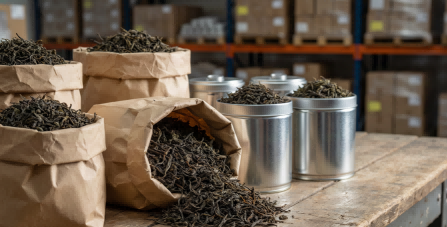
Multi-Wall Paper Sacks
Food-grade multi-wall paper sacks with an inner polyethylene (PE) liner are the standard entry-level bulk format for Chinese black tea. They are stackable, relatively inexpensive, and suitable for 20 kg to 25 kg shipments. The inner liner should meet food-contact plastic requirements [1]; outer kraft layers should comply with food-contact paper and paperboard standards [2]. For added protection, importers can request a foil barrier layer between the paper and liner.
Foil-Lined Cartons and Bulk Bags
For broken black tea grades and high-aroma lots, foil-lined cartons or woven bulk bags with aluminum-film liners reduce oxygen and moisture transfer better than plain paper sacks. These formats are often used for premium loose-leaf tea destined for repacking in the destination country. Cartons are easier to palletize and inspect than sacks, but they usually cost more and take up slightly more consolidation space.
Tea Bags and Single-Serve Formats
Portion-control formats make Chinese black tea practical for offices, cafés, hotels, and retail shoppers who want fast brewing. The packaging must protect the cut leaf and maintain label claims.
Standard Flat Tea Bags and Envelopes
Flat tea bags usually contain 2 g to 3 g of black tea and are packed into individual paper or foil envelopes. Paper envelopes are cheaper, but foil-lined envelopes retain volatile aroma compounds longer. Food-contact paper used for tea bag tag and envelope stock falls under [2], while heat-seal coatings should be documented as food-safe under the supplier’s material certification.
Pyramid Sachets and String-and-Tag Bags
Pyramid sachets made from food-grade nylon, PLA, or nonwoven material give larger leaves more room to expand. They are common in specialty retail and private label programs. String-and-tag bags remain popular in foodservice. Importers should request migration test reports for the sachet material, particularly when tea is brewed at high temperatures, because hot water increases the potential for substance migration from plastic and adhesive components [1].
Retail-Ready Packaging Formats
Retail-ready formats carry more branding weight. They must protect tea on shelves, display cleanly, and meet destination-market labeling rules.
Stand-Up Pouches and Foil Zipper Bags
Stand-up pouches with aluminum-foil or metallized-film laminates are the most versatile retail format for specialty black tea. A resealable zipper and one-way degassing valve can extend consumer shelf life after opening. These pouches are often filled with nitrogen to reduce oxygen inside the pack. Retail labels in the United States must follow FDA food labeling requirements [5]; in the European Union, the food-contact layer must comply with EU Regulation 1935/2004 [4].
Tins, Caddies, and Gift Boxes
Rigid tins and gift boxes are used for premium, gift-oriented, or seasonal products. They protect tea from crushing and light, but they cost more and add dimensional weight to air freight. Many buyers ship loose tea in bulk and add retail tins or cardboard caddies at destination to reduce shipping cost and import risk.
Choosing the Right Format
Use the table below to match the format to your channel.
| Format | Typical Unit | Barrier Level | Best Fit |
|---|---|---|---|
| Kraft multi-wall sack | 20–25 kg | Moderate | Blending, repacking, industrial extraction |
| Foil-lined carton | 10–20 kg | High | Premium loose leaf, long-distance shipping |
| Flat tea bag | 2–3 g per bag | Moderate | Foodservice, offices, everyday retail |
| Pyramid sachet | 2.5–5 g per sachet | High | Specialty retail, private label |
| Stand-up pouch | 50–250 g | High | E-commerce, retail shelves |
| Tin or caddy | 50–500 g | Very high | Gifting, premium seasonal lines |
Higher barrier materials cost more, but they protect the same lot over a longer shipping and warehouse cycle. If the tea will be blended or consumed quickly, a moderate barrier is usually sufficient. For high-aroma black teas such as Jin Jun Mei or Keemun Hao Ya, specify an aluminum-film layer at the pouch or carton level.
Get Packaging Quotes and Samples
Contact Chinese tea suppliers at 427728483@qq.com with your target format, order volume, destination market, and required food-contact documentation. Request material specifications, migration test reports, and a pre-production sample before finalizing the order.
Frequently Asked Questions
What is the safest packaging for long-distance shipping of Chinese black tea?
Foil-lined cartons or multi-wall sacks with an aluminum-film barrier and food-grade PE liner provide the best moisture and oxygen protection for long ocean shipments. Keep the outer packaging intact and avoid direct sun exposure in the container.
Can I order private label packaging for retail?
Yes. Chinese tea suppliers commonly support private label tins, stand-up pouches, and tea bag envelopes. You will need to provide approved artwork and destination-market labeling information; the supplier should supply food-contact declarations for every material in the package.
How do tea bags affect freshness compared with loose leaf?
Cut tea for bags has more exposed surface area, so aroma can fade faster unless each bag is sealed in a foil or high-barrier envelope. Loose leaf in a nitrogen-flushed foil pouch generally retains volatile aromatics better over the same period.
What certifications should packaging materials have?
Ask for food-contact compliance documents for paper and paperboard [2], plastic liners and sachet materials [1], and food safety management certification for the packing facility [3]. For the European Union, verify compliance with Regulation 1935/2004 [4]; for the United States, confirm that retail labels meet FDA Part 101 [5].
Which format is most cost-effective for bulk import?
A plain food-grade multi-wall sack with an inner PE liner is usually the lowest-cost bulk option. It works well for tea that will be repacked or blended shortly after arrival and does not require a long retail shelf life.
References
[1] National Standard of the People’s Republic of China, GB 4806.7-2016, National food safety standard — Food contact plastic materials and articles, Beijing, China, 2016.
[2] National Standard of the People’s Republic of China, GB 4806.8-2016, National food safety standard — Food contact paper and paperboard materials and articles, Beijing, China, 2016.
[3] International Organization for Standardization, ISO 22000:2018, Food safety management systems — Requirements for any organization in the food chain, Geneva, Switzerland, 2018.
[4] European Union, Regulation (EC) No 1935/2004, On materials and articles intended to come into contact with food, Official Journal of the European Union, 2004.
[5] U.S. Food and Drug Administration, Code of Federal Regulations Title 21, Part 101, Food Labeling, Washington, DC, USA.