White tea remains a small share of China’s total tea output, but buyer attention has shifted strongly toward Fuding and Zhenghe white teas over the past decade [3][5]. Gongmei sits in an awkward middle position: it is less delicate than Silver Needle and usually more defined than entry-level Shoumei [1]. That middle position is exactly why its price can look confusing. Two lots with the same label can differ sharply once grade, origin, harvest date, age, and paperwork are checked.
The Grade Ladder Sets the Floor
Gongmei is a defined white tea grade under China’s national white tea standard, not a loose marketing term [1]. The standard separates white tea into grades that track plucking standard and cultivar. Gongmei is typically made from a bud with two or three leaves, using specific Fuding and Zhenghe area cultivar groups, while Shoumei can come from broader large-leaf material [1][2]. That gives Gongmei a firmer identity than many buyers expect.
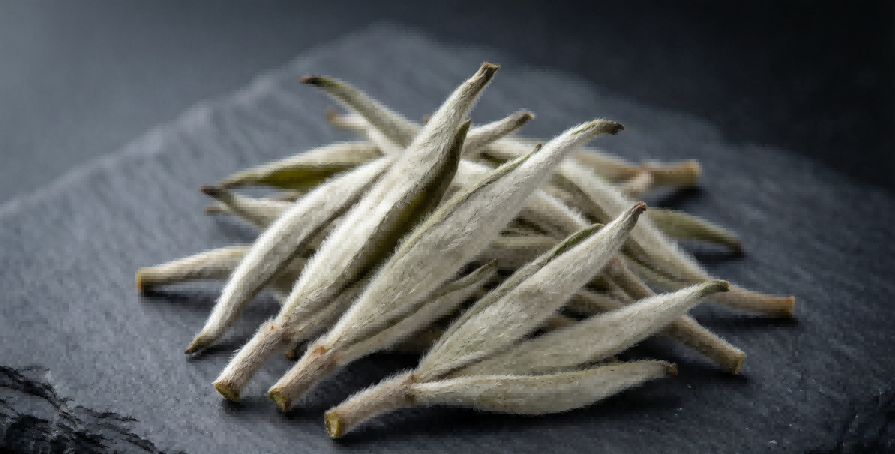
In practice, prices follow a clear ladder. Silver Needle, made mostly from buds, has the highest cost because plucking is slow and yield per bush is low. White Peony follows, then Gongmei, then Shoumei. But the gaps are not fixed. A clean spring Gongmei from a recognized Fuding garden can outprice an autumn White Peony from an unspecified origin. Grade is only the floor; it is not the final price.
Buyers should also separate “Gongmei” from aged or compressed products. A pressed Gongmei cake includes processing, pressing loss, wrapping, and storage cost. A loose-leaf Gongmei quote is usually the cleanest comparison point. If a supplier cannot state which national standard governs the lot, that is a pricing risk, not a bargain.
Origin and Harvest Window Change Everything
Fuding and Zhenghe are the two traditional white tea centres, and both carry protected-origin recognition for white tea [2]. Within those areas, village, elevation, tea bush age, and garden management all move the price. The same is true for raw material from outside the core zones: it can still be processed correctly, but it should not be quoted as if it were core-origin Fuding material.
Harvest window is the next major lever. Early spring material, with softer buds and denser leaf, is slower to pick and available in smaller volume. Later spring and autumn material is more abundant and generally less aromatic, so it trades lower [3]. Weather risk adds another layer. A dry spring can reduce early output and push fresh-grade prices upward without changing the tea’s grade name.
For wholesale buyers, the practical question is not “is this Gongmei?” but “which harvest, which village, and which cultivar group?” Those three answers should be written into the commercial invoice or packing list. If they are missing, the price cannot be benchmarked against comparable lots.
Aging, Storage, and the Premium for Provenance
Aged white tea has become one of the most heavily promoted segments in white tea, and Gongmei is often chosen for aging because its larger leaves have enough structure to change over time. Aging can add value, but it can also add fiction. There is no national rule that a “seven-year” claim automatically means better tea, and storage conditions matter more than calendar age [1][3].
A dry-stored Fujian lot that has been kept sealed and cool will usually taste cleaner and hold more value than a humid-stored lot with the same year on the wrapper. Importers should ask for harvest year, pressing date if applicable, storage location, moisture test results, and photos of the actual packed lot. Age alone should never justify a large premium.
This is where provenance documentation becomes part of the price. A lot with batch-level traceability, pesticide residue tests, and a clear storeroom trail will cost more than an anonymous lot with no chain of evidence [2][4]. Some of that premium is risk reduction, not tea quality. For a business buyer, paying for proof is often cheaper than paying for a rejected shipment later.
If you are comparing aged lots, one educational test helps: request the same harvest year from two suppliers and ask each where the tea has been stored and when it was pressed. The answers usually reveal more than the price sheet does. Before you lock an aged-lot price, send the grade, harvest year, storage location, and destination port to 427728483@qq.com for an itemized quotation.
How to Read a Gongmei Quote
A reliable wholesale quote should itemize more than a per-kilogram number. The table below separates the factors that should always be visible.
| Price driver | What it does to price | Documentation to request |
|---|---|---|
| Leaf grade | Sets the base position | Grade confirmation under GB/T 22291-2017 [1] |
| Plucking standard | Bud-to-leaf ratio affects yield | Leaf appearance and plucking date |
| Origin | Core Fuding/Zhenghe lots trade higher | Origin certificate or GI documentation [2] |
| Harvest window | Early spring costs more than autumn | Harvest date on invoices |
| Age and storage | May add value; may add risk | Storage record, pressing date, moisture test |
| Lot size | Full lots lower unit cost | Quantity and packaging breakdown |
| Certification | Organic or EU MRL compliance adds cost | Test reports and certificates |
| Logistics terms | FOB vs CIF changes landed cost | Proforma invoice with Incoterms and port |
A quote that only says “Gongmei, premium grade, USD/kg” is not a usable quote. At minimum, it should explain what the supplier means by premium. The same description appears on low-grade autumn lots and carefully stored spring lots, often with very different prices [3].
Before accepting any figure, confirm whether the price is for loose leaf or pressed material, whether it includes sorting defects, and whether it covers standard export moisture. These are not technical details; they are the difference between a landed cost that works and one that erodes margin after arrival.
Get a Gongmei White Tea Quote That Holds Up
Chinese Tea Supply works with importers and tea brands on Fuding and Zhenghe white tea sourcing. Tell us your target grade, annual volume, packaging format, and destination port, and we will return a landed-cost breakdown with lead times, QC parameters, and certification options.
Write to 427728483@qq.com with:
- Target grade and plucking standard
- Annual quantity and packing format
- Certification and pesticide-residue requirements
- Destination port and Incoterms
- Whether you need fresh, pressed, or aged lots with storage proof
FAQ
What exactly is Gongmei white tea?
Gongmei is a white tea grade defined by China’s national white tea standard, usually made from a bud and two or three leaves from specific Fuding and Zhenghe cultivar groups [1]. It sits below White Peony in the traditional grade ladder but has a more specific identity than Shoumei.
Why is Gongmei cheaper than Silver Needle but sometimes more expensive than Shoumei?
Silver Needle is mostly buds, so its yield is much lower and its price is higher. Gongmei uses a larger leaf set, which is faster to pick. It can cost more than Shoumei because the standard ties Gongmei to particular cultivar groups and often to cleaner spring material [1][2].
Does older Gongmei always command a higher price?
No. Age can add value when storage is dry and documented, but calendar age alone does not guarantee quality [3]. Poorly stored tea can lose aroma and develop off notes. Always tie an age premium to storage location, moisture tests, and actual lot photos.
How should importers verify a Gongmei price quote?
Ask for grade confirmation, origin, harvest date, storage record, moisture test, quantity, and Incoterms. The price should be benchmarked against the same harvest and origin, not just the same grade name [1][2][3].
What is the minimum order quantity for wholesale Gongmei?
It depends on packaging and whether the lot is loose leaf or pressed. Chinese Tea Supply can quote carton-level and pallet-level volumes. Send your target grade and destination port to 427728483@qq.com for a specific MOQ.
References
[1] GB/T 22291-2017, White tea (Bai Cha), Standardization Administration of China.
[2] General Administration of Quality Supervision, Inspection and Quarantine, Fuding White Tea Geographical Indication Product Protection, China National Intellectual Property Administration.
[3] China Tea Marketing Association, Annual Tea Industry Report, 2025 edition.
[4] ISO 20715:2023, Tea — Classification of tea types, International Organization for Standardization.
[5] FAO Intergovernmental Group on Tea, Current Market Situation and Medium-Term Outlook, Food and Agriculture Organization of the United Nations.