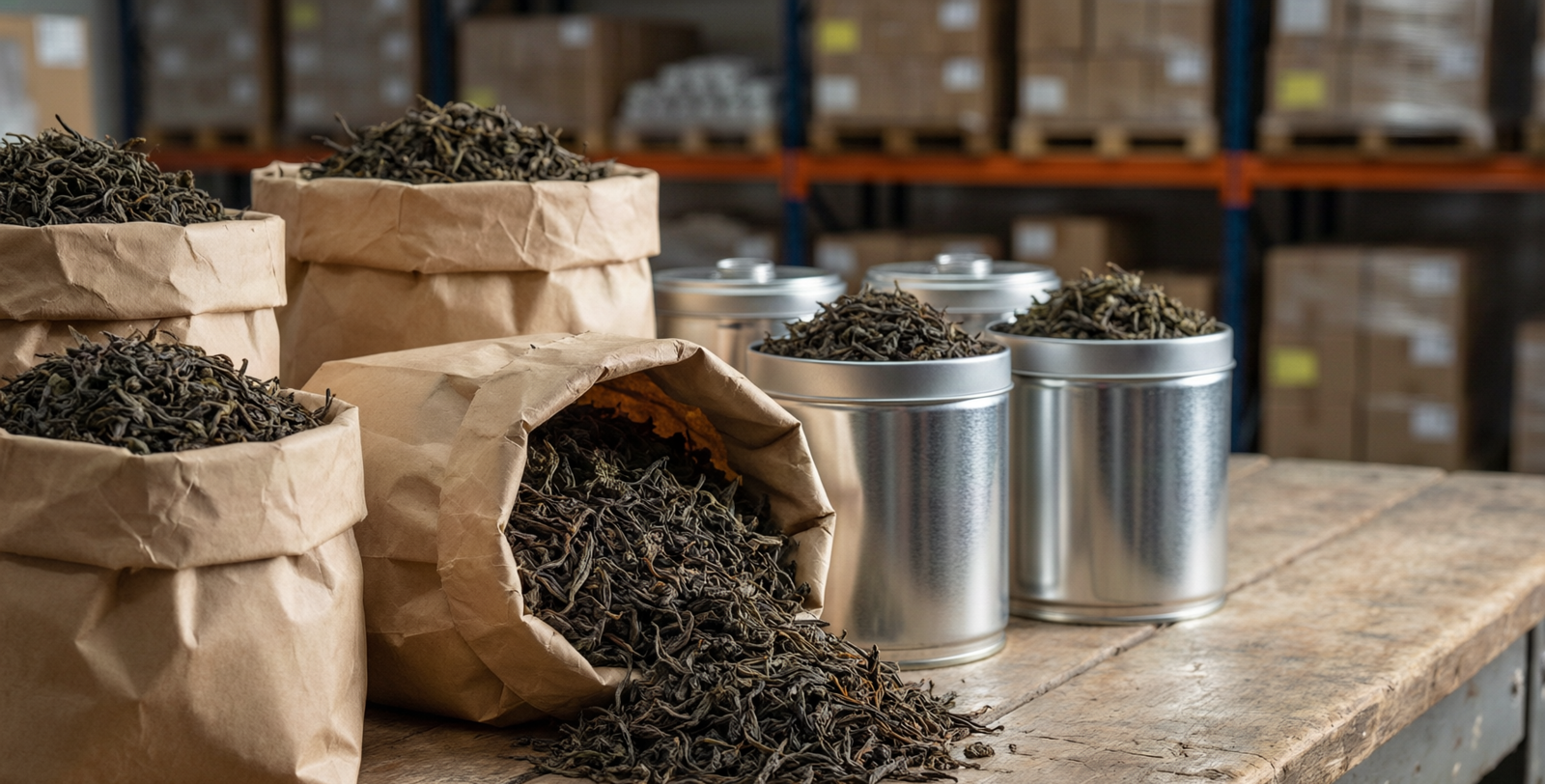
Packaging does more than keep oolong tea from spilling in transit. For importers, wholesalers, and retail buyers, the packaging format you choose shapes landed cost, shelf life, aroma retention, retail readiness, and the amount of rework needed before sale. This guide breaks down the three practical families of oolong packaging — bulk, bags, and retail options — and shows how each format performs in real supply chains.
Why Oolong Tea Needs Format-Specific Packaging
Oolong is a semi-oxidized tea. Depending on style, oxidation levels can range from roughly 10% to 70%, which gives light floral oolongs and heavily roasted rock oolongs very different storage needs [1][2]. The common threats are the same: oxygen, moisture, light, and strong ambient odors.
Packaging for oolong is therefore a barrier problem first and a branding problem second. A format that works for dense bulk freight may not preserve a high-aroma Tieguanyin long enough for retail rotation. A retail tin may look premium but add enough weight and cube to destroy your freight margin.
The right choice usually comes down to three questions:
- How long will the tea sit before it reaches the end consumer?
- Does the channel require retail-ready units or will downstream packing happen locally?
- What barrier level can the product justify at its price point?
Bulk Oolong Packaging: Vacuum Bags, Foil-Lined Cartons, and Tea Chests
Bulk formats are designed for wholesale movement, repacking, and long-term warehouse storage. They trade presentation for density and barrier efficiency.
| Format | Common Unit | Best For | Barrier Notes |
|---|---|---|---|
| Food-grade PE inner bag with woven outer sack | 5 kg, 10 kg, 20 kg | Cost-sensitive bulk leaf | Basic moisture protection; limited oxygen barrier |
| Vacuum-compressed foil or metallized bag | 5 kg, 10 kg | Aroma-sensitive spring oolong | High oxygen and moisture barrier; reduces volume |
| Foil-lined corrugated carton | 10 kg, 20 kg, 25 kg | Sea freight consolidation | Aluminum foil liner protects against humidity and odor |
| Paper or foil-lined tea chest | 20 kg+ | Premium single-origin lots | Strong stacking; often used for high-value oolong |
Vacuum-compressed bulk bags are the most important format for light oolong. Removing air limits oxidative change and also compresses the leaf, which lowers freight volume. The trade-off is leaf breakage: tightly compressed oolong can arrive with more broken pieces than loose-filled cartons. For whole-leaf and high-aesthetic grades, many suppliers recommend foil-lined cartons instead of aggressive vacuum compression.
For sea freight, outer packaging matters as much as the inner bag. Corrugated cartons should be food-grade, reinforced at the corners, and clearly marked with lot, grade, net weight, and harvest date. Tea chests are heavier but protect against pallet strapping damage and are easier to stack in long-term storage.
Bagged Oolong Formats: Nitrogen-Flushed Pouches and Loose-Leaf Sacks
Bagged formats sit between true bulk and retail. They are usually stand-up pouches, flat-bottom pouches, or side-gusset sacks that hold loose-leaf oolong in consumer or food-service quantities.
The most effective version is the nitrogen-flushed pouch. After filling, residual oxygen is replaced with nitrogen and the pouch is sealed immediately. This slows oxidation and preserves volatile aroma compounds much longer than a simple heat-sealed bag. Nitrogen flushing is common for 50 g to 1 kg retail or sample packs, but it also appears in 5 kg food-service formats.
For larger bagged units, a one-way degassing valve is sometimes used, though oolong typically releases less gas than fresh dark tea. The more important features are:
- Multi-layer barrier film, usually PET/aluminum foil/PE or PET/metallized PET/PE
- A strong zip lock or resealable top for food-service use
- Tear notch or easy-open seal
- Opaque or metallized outer layer to block light
Loose-leaf sacks without barrier film are adequate only for short transit or immediate repacking. They are cheaper, but importers who hold inventory for more than a few months should not treat them as long-term packaging.
Retail-Ready Oolong Packaging: Tins, Boxes, Sachets, and Gift Sets
Retail-ready packaging moves oolong directly from carton to shelf. It includes folding cartons, rigid gift boxes, sealed tins, inner sachets, pyramid tea bags, and single-serve envelopes.
| Format | Typical Placement | Benefits | Main Risk |
|---|---|---|---|
| Folding carton with inner pouch | Supermarket, tea shop | Lower cost than tins; easy to brand | Inner pouch must be resealable or tight |
| Reclosable tin or canister | Specialty retail | Excellent light and odor protection | Higher unit cost and freight weight |
| Pyramid tea bag or sachet | Food service, office, convenience | Portion control; fast brewing | More processing and packaging cost |
| Gift box set | Seasonal and premium gifting | High perceived value | High cube; delicate in transit |
Private-label retail boxes are possible on first orders, but they carry higher MOQs because printing plates or digital setup costs must be absorbed. Suppliers commonly quote retail box MOQs from 1,000 to 5,000 boxes per design, while plain bags or tins can often start lower. Confirm the exact requirement before artwork is produced.
Retail packaging must also meet labeling rules before import. In the EU, mandatory food information includes the name of the food, net quantity, list of ingredients if relevant, and the name and address of the responsible food business operator [3]. The U.S. FDA requires a statement of identity, net quantity, and manufacturer, packer, or distributor declaration [4]. Country-of-origin labeling is required in many markets, and some distributors expect a lot code for traceability even when not strictly mandatory.
How Packaging Format Changes MOQ, Pricing, and Freight
The format changes the economics more than most buyers expect.
| Factor | Bulk | Bagged | Retail-Ready |
|---|---|---|---|
| Cost per kilogram | Lowest | Medium | Highest |
| Typical MOQ | Low; often 5–20 kg per grade | Medium; often 20–100 kg per SKU | High; often 1,000+ units per design |
| Freight density | High | Medium | Low to medium |
| Damage risk | Low | Low | Higher for tins and gift boxes |
| Rework before sale | High | Low to medium | None |
Bulk packaging is the most efficient way to build a custom blend or private label downstream. It lets you control final packing in your own market, but it requires packaging equipment and a local rework partner.
Bagged formats are often the best value for e-commerce and small retail. They protect the tea, are light enough for parcel shipping, and can carry a complete brand look without the cost of rigid packaging.
Retail-ready formats produce the highest perceived value but add the most landed cost. Tins and rigid boxes increase weight and cube quickly, especially for air freight. For sea freight, cube is the larger problem: a container of loose tins may carry significantly less tea by weight than the same container of bulk cartons.
Food Safety, Shelf Life, and Labeling by Format
Food safety starts with the materials, not just the tea. Inner packaging should be food-grade, and suppliers should be able to provide material compliance documents for food contact. A structured food safety management system based on ISO 22000 or equivalent is a useful supplier filter [5].
Shelf life expectations vary by format and oolong style:
- Vacuum-sealed bulk bags: longest practical shelf life; many suppliers declare 18–24 months for sealed units.
- Nitrogen-flushed pouches: similar or slightly shorter, often 12–18 months depending on seal quality.
- Retail boxes or tins: shelf life depends on the inner pouch; the outer package itself does not extend life.
- Light floral oolongs: degrade faster than heavily roasted oolongs, so stronger barrier packaging is worth the cost.
- Roasted oolongs, including Wuyi rock styles: more stable and can tolerate simpler packaging longer.
These are supplier-declared ranges, not guarantees. The actual shelf life depends on storage temperature, humidity, seal integrity, and exposure after opening. Importers should ask for a written shelf-life declaration per SKU and test long-stored samples before large reorders.
Labeling must be considered before packaging is produced. Net quantity statements should be accurate in the destination country’s units. Batch or lot codes support traceability and recall readiness. For private-label retail, the responsible food business operator must be identified correctly; the name on the box should match the legal importer or distributor, not necessarily the factory.
Choosing the Right Oolong Packaging for Your Channel
Start with the final buyer, then work backward.
- For wholesale clubs and food service: large nitrogen-flushed pouches or foil-lined cartons are practical.
- For specialty tea shops and e-commerce: retail bags or small tins with private label design.
- For grocery chains: folding cartons with clear net weight, lot, and origin information.
- For gift and seasonal channels: rigid boxes, but plan freight carefully and order early.
- For long-term private label: buy bulk and pack locally, or place high-MOQ retail orders with a trusted Chinese supplier.
A single supplier should be able to show you all three format families, not just the one they prefer to pack. Ask for samples of the actual packaging film, not just tea samples. The film, seal, valve, and box strength determine whether the tea survives the journey.
Get Oolong Packaging Options Matched to Your Sales Channel
Need bulk vacuum packs for long-term storage, nitrogen-flushed retail pouches, or fully branded gift boxes? We help wholesale buyers compare packaging formats, barrier levels, MOQs, and landed cost before committing to a production run.
Contact Chinese tea suppliers at 427728483@qq.com with your target market, order volume, and packaging preference. We will reply with format recommendations, sample availability, and current pricing for oolong tea.
Frequently Asked Questions
What is the best packaging for long-term oolong storage?
Vacuum-sealed aluminum foil or metallized bags inside foil-lined cartons provide the strongest practical barrier against oxygen and moisture. Nitrogen flushing adds another layer of protection. Heavily roasted oolongs are more forgiving than light floral styles.
How does nitrogen flushing extend oolong shelf life?
Nitrogen replaces oxygen inside the sealed pouch. Since oxygen drives oxidation and aroma loss, removing most of it slows the changes that make oolong taste flat or stale over time.
What MOQ should I expect for retail-ready oolong packaging?
Plain tins and pouches often start below 1,000 units. Printed folding cartons and custom gift boxes usually start around 1,000 to 5,000 units per design because of plate or digital setup costs. Confirm before preparing artwork.
Are vacuum-packed bulk oolong bags food safe?
They should be made from food-grade films and heat-sealed with food-contact materials. Ask the supplier for food-contact compliance documents, and verify that the outer cartons are clean, dry, and free of strong odors.
Which packaging format is cheapest for freight?
Bulk vacuum-compressed or foil-lined carton formats are generally cheapest per kilogram because they are dense and stack efficiently. Retail tins and rigid gift boxes add the most weight and cube per kilogram of tea.
Can I use private label retail boxes on my first oolong order?
Yes, but you will likely need to meet a higher MOQ and approve digital proofs or pre-production samples. Ordering plain bags or tins first, then moving to custom boxes, is often a lower-risk way to test the product.
References
[1] ISO 20715:2023, Tea — Classification of tea types, International Organization for Standardization, Geneva, 2023.
[2] GB/T 30357.1-2013, Oolong tea — Part 1: Basic requirements, Standardization Administration of China, Beijing, 2013.
[3] Regulation (EU) No 1169/2011 of the European Parliament and of the Council on the provision of food information to consumers, Official Journal of the European Union, 2011.
[4] U.S. Food and Drug Administration, Food Labeling Guide, U.S. Department of Health and Human Services.
[5] ISO 22000:2018, Food safety management systems — Requirements for any organization in the food chain, International Organization for Standardization, Geneva, 2018.